
Does Emergen C Expire? Shelf Life, Safety, and Potency Explained
This article has been reviewed by Dr. Sana Lodhi (General Medicine), specializing in primary care, nutritional supplement safety, and preventive health management.
Medical Disclaimer: The information provided on Health Page regarding the shelf life, potency degradation, and safety of Emergen-C or other vitamin supplements is for educational and informational purposes only. Dietary supplements can lose efficacy over time or degrade if exposed to moisture and heat. Always consult a qualified healthcare professional or physician before consuming expired supplements or if you have specific health concerns regarding nutritional intake.
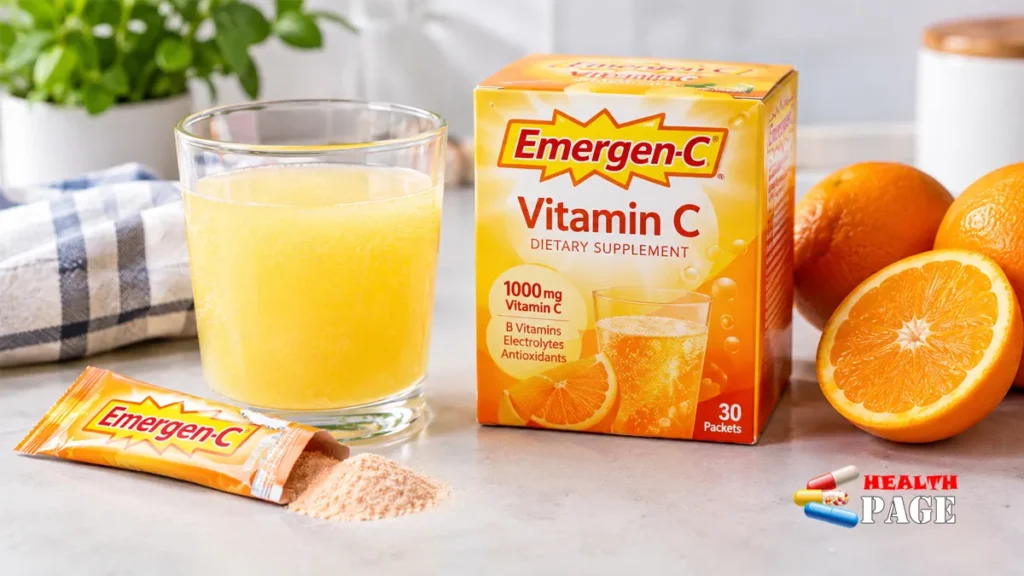
Finding an old packet of Emergen-C in a kitchen cabinet can raise a simple question: Does Emergen C expire? Yes. Emergen-C products have a labeled shelf-life or Best By date, and that date matters because the manufacturer establishes product quality and potency for a defined period under appropriate storage conditions. Once that period has passed, you can no longer assume the supplement retains the same quality or vitamin C potency.
That does not mean the powder suddenly becomes poisonous at midnight on the printed date. Vitamin C degradation is generally a gradual chemical process influenced by factors such as temperature, moisture, oxygen and storage conditions. The practical question is therefore less about whether an expired packet instantly becomes dangerous and more about whether it is still a reliable way to get the amount of vitamin C stated on the label.
For most people, replacing an expired packet with a fresh one is the simplest way to remove that uncertainty.
Does Emergen C Expire?
Yes. Emergen-C is a dietary supplement containing vitamin C and other ingredients, and the manufacturer’s current product labeling provides storage instructions and a clear quality standard for the product.
The current Emergen-C 1,000 mg Vitamin C label instructs consumers to store the product at room temperature, protect it from moisture, and not use a packet if its seal is torn or broken.
The date printed on a supplement should not be interpreted as a magical point at which every ingredient changes at once. Rather, it represents the manufacturer’s established shelf-life period. The U.S. Food and Drug Administration explains that expiration dating for products is connected to stability—the ability to maintain expected strength, quality and purity under specified storage conditions. For dietary supplements specifically, FDA says an expiration date is not universally required, but when a manufacturer includes one, it must be supported by valid data and not be false or misleading.
That distinction is particularly useful with vitamin C because ascorbic acid is chemically sensitive.
What Does the Emergen-C Expiration Date Mean?
Think of the Emergen-C expiration date or Best By date as a manufacturer’s confidence boundary rather than a chemical countdown timer.
Within the stated shelf life, and assuming the product has been stored as directed, the manufacturer has established that the product should meet its intended quality specifications. After that date, the original assurance no longer applies.
Several factors can influence how well a packet remains stable:
- The age of the product
- Exposure to heat
- Exposure to humidity or moisture
- Oxygen exposure
- Condition of the packet
- The formulation and packaging
- How consistently the product was stored according to its label
This is why two packets of the same product that are the same age may not have experienced exactly the same degree of degradation.
The distinction is also important when discussing expired dietary supplements generally. A supplement being beyond its labeled date does not automatically prove that every ingredient has become harmful. It means the product is outside the period for which the manufacturer established its intended quality and potency.
Can You Drink Expired Emergen-C?
If you are wondering, can you drink expired Emergen-C, the most practical answer is: it is better to replace it with a fresh packet.
That recommendation does not mean an expired packet suddenly becomes poisonous. There is no sound basis for describing the expiration date as an instant toxicity switch.
The bigger concern is uncertainty.
Once Emergen-C is past its labeled shelf life, the manufacturer no longer guarantees that it retains its original quality and potency. You also cannot determine the exact amount of remaining vitamin C simply by looking at the powder.
For example, a packet that expired recently and was kept sealed in a dry cupboard may look completely normal. That appearance does not tell you whether its vitamin C content remains exactly at the labeled amount.
On the other hand, an old packet that was stored in a hot, humid environment has a less favorable storage history, making replacement an even more sensible choice.
So rather than creating an arbitrary rule such as “Emergen-C is safe for six months after expiration,” it is more accurate to say:
The farther a product is beyond its labeled date, and the poorer its storage history, the less confidence you should have in its original quality and potency.
What Happens When Vitamin C Powder Expires?
So, what happens when vitamin C powder expires?
Vitamin C does not simply stop working on a particular day. Ascorbic acid can gradually undergo chemical degradation, and environmental conditions can affect the rate.
Scientific research has examined the stability of ascorbic acid under different temperatures and oxygen conditions. Other research specifically examining vitamin C powder found that temperature and humidity influence discoloration and degradation.
In practical terms, an aging vitamin C product may gradually contain less active vitamin C than it originally did.
That is why it would be misleading to say that all expired Emergen-C contains a particular percentage less vitamin C. There is no universal number that applies to every packet because degradation depends on formulation, packaging, time and storage conditions.
A useful way to think about it is:
Time + unfavorable storage conditions → greater potential for degradation → less certainty about potency.
This is different from saying:
Expiration date reached → product instantly becomes toxic.
The first explanation reflects what stability science can actually tell us.
Signs That Emergen-C Has Gone Bad
The date on the package is important, but physical changes can provide additional reasons to discard a packet.
Moisture exposure
Emergen-C is a dry powder, and the manufacturer’s label specifically says to protect it from moisture. A packet that has clearly been exposed to moisture deserves caution.
Significant clumping or hardening
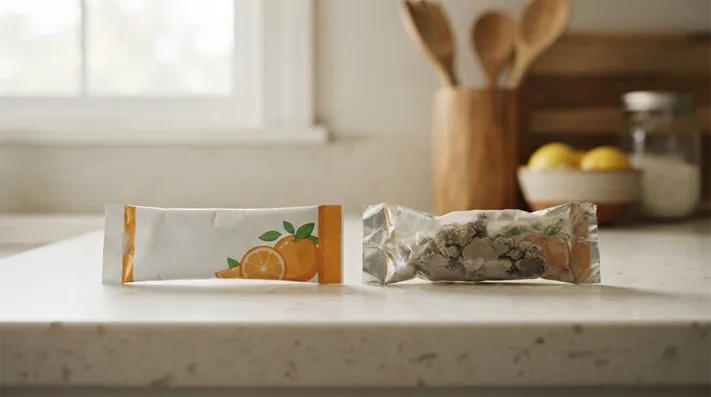
Minor changes in powder texture do not automatically prove that a product is unsafe. However, substantial clumping or hardening can suggest moisture exposure, particularly if the packet was stored somewhere humid.
Unexpected color changes
A noticeable change from the product’s normal appearance can be a reason not to use it. Color changes alone cannot tell you exactly what chemical changes have occurred, but they are useful warning signs when combined with age or poor storage.
Unusual odor
If the powder smells distinctly different from normal, particularly if the odor is unpleasant or unexpected, discarding it is the sensible option.
Torn or broken packet
This one is straightforward. The current manufacturer labeling says not to use Emergen-C if the packet seal is torn or broken.
Unexpected appearance after mixing
If a freshly prepared drink has an unusual appearance, odor or other unexpected characteristic, it is better not to consume it.
One important limitation applies to all of these signs: a packet can look normal while some vitamin C has already degraded. Appearance is not a laboratory test of potency.
How to Properly Store Vitamin C Supplements
Knowing how to properly store vitamin C supplements can help protect their quality during the intended shelf life.
For Emergen-C powder, the manufacturer’s current instructions are simple: store at room temperature and protect from moisture. The label also says not to use a packet with a torn or broken seal.
A practical storage routine looks like this:
- Keep individual packets sealed until you are ready to use them.
- Store them in a cool, dry indoor location.
- Keep them away from excessive heat.
- Avoid places with repeated humidity, such as a steamy bathroom.
- Do not leave packets in a hot car.
- Avoid direct sunlight or other unusually hot locations.
- Follow the product label rather than assuming refrigeration is necessary.
The goal is not to create special storage conditions. It is simply to avoid exposing the powder to conditions known to make chemical stability more difficult.
Why moisture matters
Humidity deserves particular attention because it can affect powdered formulations.
Research on vitamin C powder has found that relative humidity and temperature can influence degradation. Separate studies of ascorbic acid formulations have likewise found that moisture and temperature can affect stability.
That helps explain why the Emergen-C label specifically says to protect the powder from moisture.
A dry, sealed packet is better protected than a packet exposed repeatedly to humid air.
Does an Expired Emergen-C Still Contain Vitamin C?
It may still contain vitamin C, but you should not assume that it contains the full amount stated on the original label.
Vitamin C, also known as L-ascorbic acid, is a water-soluble vitamin used in many dietary supplements. The NIH Office of Dietary Supplements notes that vitamin C is susceptible to heat and that ascorbic acid is the most common form used in supplements.
The amount remaining in an older product can depend on:
- How long it has been stored
- Temperature exposure
- Humidity
- Oxygen exposure
- Packaging integrity
- The specific formulation
- Whether it remained sealed
This is why a universal statement such as “expired Emergen-C loses 50% of its vitamin C” would be unsupported.
If reliable vitamin C intake is the reason you are using the product, a fresh packet provides much greater certainty than trying to estimate how much remains in an expired one.
Is Emergen-C Dangerous After the Expiration Date?
An expired Emergen-C packet is not automatically dangerous simply because the date has passed.
However, that does not make it equivalent to a fresh packet.
The manufacturer establishes a shelf-life period under specified conditions. Once the product is beyond that period, its original quality and potency are no longer guaranteed.
There is another distinction worth making: vitamin C itself has relatively low toxicity at ordinary supplemental amounts, although high intakes can cause gastrointestinal problems such as diarrhea, nausea and abdominal cramps. The NIH Office of Dietary Supplements provides information on recommended intakes and upper intake limits.
That information should not be interpreted as permission to use an expired supplement indefinitely. The question of expiration is primarily about the condition and reliability of the product, not simply the inherent toxicity of vitamin C.
If the packet is expired and damaged, moisture-exposed, unusually discolored, strongly clumped or otherwise abnormal, there is little reason to take the risk of using it.
What If Emergen-C Expired Only Recently?
This is where many readers want a precise answer, but science does not provide a universal “safe for X days” rule for expired Emergen-C.
There is no scientifically justified cutoff saying that a packet is fine for exactly 30 days, six months or one year after its printed date.
Stability depends on the product and its storage conditions.
A packet that is only slightly beyond its date and remained sealed and properly stored may not have undergone the same degree of degradation as a packet that spent months in high heat and humidity. But consumers generally do not have the equipment needed to measure the remaining vitamin C concentration at home.
For that reason, the practical approach is simple: use the labeled shelf life as intended and replace expired packets rather than trying to calculate their remaining potency.
What If the Packet Was Exposed to Humidity?
Storage conditions can matter even before the printed date.
For example, imagine a box stored in a humid bathroom for months. The packets may technically still be within their labeled shelf life, but repeated moisture exposure is not the storage environment the manufacturer recommends.
This is why expiration dating should always be understood together with storage instructions.
An in-date packet that has a compromised seal or obvious moisture exposure is not automatically equivalent to an intact packet that has been stored correctly.
If the powder is noticeably clumped, the packet is damaged, or moisture has clearly entered the package, replacing it is the sensible option.
Expired vs. Properly Stored Emergen-C
| Situation | Main consideration |
|---|---|
| Within date + properly stored | Expected quality and potency under labeled conditions |
| Within date + moisture exposure | Stability may have been affected |
| Within date + torn or broken packet | Manufacturer says not to use |
| Slightly past date + good storage | Original potency is no longer guaranteed |
| Far past date | Greater uncertainty about quality and potency |
| Expired + moisture or significant clumping | Replacement is the safer practical choice |
| Expired + damaged packet | Do not use |
| Expired + unusual appearance or odor | Discard rather than consume |
This comparison avoids pretending that an expiration date predicts an exact moment of chemical failure.

Does Mixing Emergen-C With Water Change Anything?
Yes. Once the dry powder is mixed with water, you are dealing with a solution rather than the original dry formulation.
Ascorbic acid is sensitive to environmental conditions in solution, including oxygen and temperature. Research has demonstrated that these factors can influence vitamin C stability.
That does not mean a prepared glass suddenly becomes unsafe. It simply means the dry packet and prepared drink should not be treated as identical storage situations.
The manufacturer’s directions say to empty one packet into a glass, add 4–6 ounces of water and stir.
For best practice, prepare the drink when you intend to consume it rather than mixing it and leaving it sitting around unnecessarily.
Other Vitamin C Supplements Have the Same Basic Stability Issue
Emergen-C is only one type of vitamin C supplement. Tablets, powders and combination formulas can have different formulations and packaging, so their specific storage instructions should always take priority.
For example, readers comparing Emergen-C with another multivitamin or vitamin supplement can review the product’s ingredients, dosage and storage instructions rather than assuming every vitamin C product has the same shelf life.
If you are comparing vitamin C-containing supplements, you may also find our guide to Surbex Z and its vitamin and mineral ingredients useful for understanding how a different supplement is formulated. The products are not interchangeable, so their labels should be checked individually.
Who Should Be More Careful With Supplement Use?
The expiration question is separate from whether a person should take a particular supplement.
Emergen-C’s current labeling advises people who are pregnant, nursing or taking medication to consult a doctor before use.
It is also worth remembering that vitamin C supplements are not necessarily needed by everyone. The NIH notes that many people can obtain vitamin C through foods such as citrus fruits, peppers, kiwifruit, broccoli and strawberries.
If you are taking vitamin C because of a diagnosed deficiency, a medical recommendation or a specific health concern, relying on an expired supplement is especially unnecessary when a fresh product is available.
Frequently Asked Questions
Can expired Emergen-C make you sick?
An expired packet does not automatically become poisonous when the date passes. However, its original quality and potency are no longer guaranteed. If it is also damaged, moisture-exposed, unusually discolored, strongly clumped or otherwise abnormal, it should be discarded.
How long does Emergen-C last after the expiration date?
There is no reliable universal period that applies to every Emergen-C packet. Storage temperature, humidity, packaging and the amount of time beyond the labeled date can all affect stability. The manufacturer’s labeled shelf life should be followed rather than using an arbitrary grace period.
Can you use Emergen-C if the powder is clumpy?
Significant clumping can indicate moisture exposure, particularly in a powdered product. Because the manufacturer instructs users to protect Emergen-C from moisture, a packet with substantial moisture-related changes is better replaced.
Does vitamin C lose potency over time?
Yes. Vitamin C can undergo chemical degradation, and factors such as temperature, oxygen and humidity can affect stability. The exact amount of potency lost depends on the product and storage conditions rather than simply the number of days since manufacture.
Should Emergen-C be refrigerated?
The current Emergen-C label says to store the product at room temperature and protect it from moisture. Refrigeration is therefore not listed as a necessary storage condition for the powdered product.
What is the best way to store Emergen-C?
Keep the packets sealed, store them at room temperature, protect them from moisture and avoid excessive heat. Do not use a packet if its seal is torn or broken.
Conclusion
Does Emergen-C expire? Yes. Emergen-C has a labeled shelf-life period, and the manufacturer provides storage instructions intended to help preserve product quality.
The expiration date should not be viewed as a moment when the powder suddenly turns toxic. The more relevant concern is that vitamin C and other components can gradually lose stability and potency, particularly when exposed to unfavorable conditions such as heat and moisture.
If your Emergen-C is expired, replacing it with a fresh packet is the most reliable choice because the manufacturer no longer guarantees its original quality and potency beyond the labeled shelf life. There is no need to invent a precise number of “safe” days after expiration when the available evidence does not support one.
For unopened packets that are still within date, proper storage is straightforward: keep them at room temperature, protect them from moisture, keep the individual packets sealed and avoid damaged packaging.
In short, an old packet may not suddenly become dangerous when its date passes, but a fresh packet gives you much greater confidence that you are getting the vitamin C and product quality stated on the label.
References
- Emergen-C — Current 1,000 mg Vitamin C product labeling — Manufacturer labeling covering ingredients, directions, storage at room temperature, moisture protection and damaged-packet precautions.
- FDA — Dietary Supplement Labeling Guide: Expiration Dating — FDA guidance explaining that expiration dating is not universally required for dietary supplements but, when used, must be supported by valid data.
- NIH Office of Dietary Supplements — Vitamin C Fact Sheet for Health Professionals — Authoritative information on vitamin C, ascorbic acid, dietary sources, supplement forms, intake and safety.
10 Amazing 0 Calorie Foods That Boost Your Health

Dr. Sana Lodhi is a qualified medical doctor (MBBS) with a strong commitment to patient care and evidence‑based medicine. With years of clinical experience and her current role at Liaquat University of Medical & Health Sciences (LUMHS), she brings trusted medical insights to readers, simplifying complex health topics into clear, practical guidance. Her passion lies in promoting preventive healthcare, empowering individuals to make informed decisions, and bridging the gap between medical knowledge and everyday wellness. At HealthyPost.co.uk, Dr. Lodhi shares expert perspectives on health, lifestyle, and medical awareness to help readers live healthier, more balanced lives.
Pingback: Orange Slice Nutrition: Calories, Vitamin C & Benefits