

Red Circle on Skin Not Itchy: Common Causes and When to See a Doctor

Dr. Jacob Cote, MD, FRCPC, is a board-certified dermatologist practicing at The Ottawa Hospital in Ontario, Canada. Specializing in medical dermatology, clinical skin pathology, and advanced acne therapies, Dr. Cote brings years of institutional hospital experience to the editorial board. He is dedicated to translating complex, evidence-based dermatological research into practical preventative skin health strategies for everyday readers. At HealthPage, he ensures all clinical guidelines and skincare recommendations are rigorously reviewed and align with current Canadian Dermatology Association standards.
Medical Disclaimer: This content is for informational and educational purposes only and does not constitute professional medical advice, diagnosis, or treatment. Always seek the advice of your physician or other qualified health provider with any questions you may have regarding a medical condition.
Written by Dr. Jacob Cote (Dermatology).
Finding a red circle on skin not itchy can be surprisingly unsettling. It does not hurt. It does not burn. It just sits there, quietly demanding attention every time you catch it in the mirror. In our medical editorial practice, we often hear the same question from patients and readers: “If it is not itchy, is it still something to worry about?” The answer is: sometimes no, sometimes yes. A round mark without itch may be harmless, but it can also point to a condition that deserves a closer look.
That uncertainty is what makes this topic important. A round red patch on skin no itch can come from several very different causes, from a mild inflammatory skin change to an early sign of infection. Some fade on their own. Others need prescription treatment. And because skin lesions that don’t itch are easy to ignore, people often wait longer than they should.
If you are also dealing with dryness, sensitivity, or other visible changes, related topics such as How Does Eczema Develop and Harm Skin Health and Fix Blotchy Skin and Red Blotchy Skin on Legs can add useful context.
Why a Non-Itchy Red Circle Can Be Hard to Identify
When a rash itches, the list of likely causes often narrows quickly. Without itch, diagnosis becomes more nuanced. In clinic-style assessments, we look at pattern, timing, scale, border, color, location, and whether there are body-wide symptoms.
A ring shaped rash not itchy may be caused by:
- Local inflammation in the deeper layers of skin
- A reaction after an insect or tick bite
- Dry skin or early eczema
- Autoimmune or immune-mediated conditions
- Pressure, friction, or minor trauma
- Less commonly, infection that does not behave like classic ringworm
Most studies agree that the appearance alone is not enough to confirm the cause. That is why doctors use a differential diagnosis for annular erythema, a medical way of saying: “What conditions can create a circular red lesion?”
1. Granuloma Annulare
One of the most common explanations for a painless red circle on skin causes is granuloma annulare. This condition often creates small, firm bumps arranged in a ring. The center may look normal or slightly sunken, while the edge appears pink or red.
In our review of patient histories, this is one of the easiest conditions to confuse with fungal rash. But there are clues.
What it usually looks like
- Smooth ring or arc shape
- Often on hands, feet, wrists, or ankles
- Little to no itch
- Usually not scaly
- May persist for months
This matters because people often assume any ring-shaped mark must be ringworm. Yet ringworm vs granuloma annulare is a classic diagnostic mix-up. Ringworm often has a scaly advancing edge and may itch. Granuloma annulare usually feels smoother and is not caused by fungus.
A non itchy red ring on skin treatment for granuloma annulare may include observation, topical steroids, or in some cases injected medication from a dermatologist. Many cases improve over time without aggressive treatment.
For background from a trusted source, see granuloma annulare on PubMed Bookshelf.
2. Lyme Disease and the Bullseye Rash
A red ring can also be an early sign of Lyme disease. This is one of the most important causes not to miss. The rash, called erythema migrans, may appear several days to weeks after a tick bite. It is often painless. It is often not itchy. And many people do not remember the bite.
Clues that raise concern
- Recent time in grassy, wooded, or rural areas
- A spreading circular or target-like rash
- Fatigue, body aches, low fever, or headache
- Rash that expands over days
Not every Lyme rash has the textbook “bullseye” look. Some are evenly red. Others are oval rather than perfectly round. That is why context matters. If a red ring on skin symptoms appears after possible tick exposure, prompt medical advice is important. Antibiotics may be needed, and early treatment can reduce the risk of later complications.
Real-life example: a patient notices a faint red circle behind the knee after a hiking weekend. It does not itch, so they ignore it. A week later, they feel run-down and achy. That pattern should trigger a same-week medical review.
3. Pityriasis Rosea and the “Herald Patch”
Pityriasis rosea often begins with one larger patch, sometimes called a herald patch. It can look like a round red patch on skin no itch on the chest, back, or abdomen. Days or weeks later, smaller spots may follow.
Common features
- One larger oval patch first
- Fine scale, though sometimes subtle
- Trunk is a common location
- May be mildly itchy, but not always
- Often self-limited
This is one reason a ring shaped rash not itchy should not automatically be labeled fungal. Early pityriasis rosea may look deceptively simple.
You can review NHS guidance on pityriasis rosea.
4. Nummular Eczema Can Start Quietly
Eczema does not always arrive with intense itching. In its early phase, nummular eczema, also called discoid eczema, may begin as round red patches on body not itchy, especially in very dry skin. Over time, those patches may become flaky, cracked, or more irritated.
Watch for these signs
- Coin-shaped patches
- Dry or rough texture
- Often on arms or legs
- Can later become itchy or ooze
This is where skin history helps. If you already struggle with dry, reactive skin, eczema becomes more likely. Readers exploring How Does Eczema Develop and Harm Skin Health often notice overlap with these early, less dramatic symptoms.
A non itchy red ring on skin treatment in this setting usually focuses on restoring the skin barrier. Fragrance-free moisturizers, gentler cleansing, and sometimes topical anti-inflammatory medication may help reduce flaring.

5. Psoriasis Can Be Round and Mild at First
Psoriasis is often imagined as thick, silvery plaques, but it does not always start that way. Some forms begin as small red patches with minimal scaling. In early or milder cases, painless red spots on skin may be the first clue.
What may point toward psoriasis
- Well-defined borders
- Family history of psoriasis
- Scalp flakes or nail changes
- Patches on elbows, knees, trunk, or lower back
A key difference is persistence. Psoriasis lesions tend to linger or recur. They may also become more obviously scaly over time. If the patch stays for weeks and standard moisturizers do little, professional evaluation becomes more important.
For general information, NHS covers psoriasis.
6. Contact Irritation, Friction, or Pressure Marks
Sometimes the answer is simple. A waistband, sports bra seam, watch strap, adhesive, or harsh soap can leave a circular or oval mark that is red but not especially itchy.
Common everyday triggers
- Tight clothing or repeated rubbing
- New body wash or detergent
- Athletic gear
- Heat and sweat
- Minor suction or pressure
These marks usually improve when the trigger is removed. They are less likely to spread dramatically and less likely to have a raised border.
If skin has become more reactive overall, you may also find related reading helpful, including Fix Blotchy Skin and Red Blotchy Skin on Legs.
7. Less Common Causes Doctors May Consider
When a lesion does not fit the usual patterns, clinicians widen the differential diagnosis for annular erythema. This can include:
- Fixed drug eruption
- Subacute cutaneous lupus
- Erythema multiforme
- Insect bite reactions
- Vascular changes or purpura
- Rare inflammatory or autoimmune skin disorders
That does not mean every mark is serious. It means persistent or unusual lesions deserve proper pattern recognition. A skin biopsy is occasionally needed when appearance alone is not enough.
Quick Comparison Table
| Condition | Typical Look | Itchy? | Scale Present? | When to Seek Care |
|---|---|---|---|---|
| Granuloma annulare | Smooth ring of small bumps | Usually no | Usually no | If persistent, spreading, or uncertain |
| Lyme disease rash | Expanding red patch or bullseye | Usually no | No | Promptly, especially after tick exposure |
| Pityriasis rosea | One oval herald patch, then more spots | Often mild or none | Fine scale possible | If diagnosis unclear or symptoms worsen |
| Nummular eczema | Coin-shaped dry patch | May start mild | Often yes over time | If cracking, spreading, or not improving |
| Psoriasis | Well-defined red plaque | Variable | Often yes | If persistent or recurrent |
| Friction/contact irritation | Localized red mark | Often mild or none | Usually no | If trigger removal does not help |
What You Can Do at Home First
If you notice a red circle on skin not itchy, a few simple steps are reasonable while you monitor it.
Try this short checklist
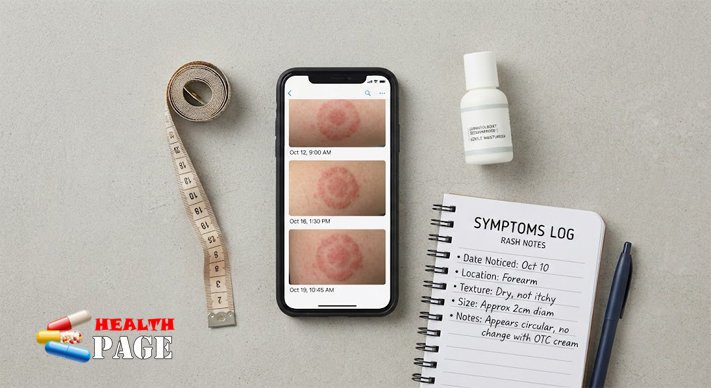
- Take a clear photo on day one
- Measure the patch or compare it to a coin
- Avoid scrubbing, picking, or applying multiple creams at once
- Use a bland moisturizer if skin looks dry
- Pause new soaps, fragrances, or adhesives
- Watch for spreading, scaling, warmth, or new symptoms
This approach helps because skin changes are easier to judge over time than from memory. In our experience, photos often reveal whether a patch is stable or expanding.
Be cautious with self-treatment. An antifungal cream may not help a non-fungal condition. A steroid cream may mask or worsen certain infections. If you are unsure, less is often safer until a clinician reviews it.
People who are also managing hormone-related or pigment concerns sometimes ask whether skin changes connect to broader beauty or health issues. Related placeholders on your site such as Does Vaping Cause Acne? and How to remove melasma can support readers with overlapping concerns, though they address different conditions.
When to See a Doctor
A round mark that does not itch is not automatically urgent. But some features should move it up your list.
Make an appointment sooner if:
- The patch expands over days
- It develops a target or bullseye shape
- It lasts longer than 2 to 4 weeks
- You have fever, fatigue, headache, joint pain, or swollen glands
- The area becomes warm, tender, swollen, or starts oozing
- You recently had a tick bite or outdoor exposure in a high-risk area
- You have many painless red spots on skin appearing at once
The biggest red flag is change. Stable marks are often less concerning than lesions that grow, multiply, or come with whole-body symptoms.
FAQs
Can ringworm be non-itchy?
Yes. Ringworm can sometimes be mild or barely itchy, which is why ringworm vs granuloma annulare can be confusing. But ringworm often has more surface scale and a clearer advancing edge.
Is a round red patch on skin no itch usually serious?
Not usually, but it depends on the cause. Many are benign inflammatory or irritation-related lesions. Still, a spreading patch or one linked to tick exposure should be checked.
What are common causes of non itchy circular rash?
Common causes include granuloma annulare, Lyme disease rash, pityriasis rosea, early nummular eczema, psoriasis, and contact irritation. These are among the better-known causes of non itchy circular rash seen in practice.
What is the best non itchy red ring on skin treatment?
Treatment depends on the diagnosis. Moisturizers may help dry, non scaly red patches on skin, while inflammatory rashes may need prescription creams and Lyme disease needs antibiotics. There is no one-size-fits-all approach.
Can dry skin cause round red patches on body not itchy?
Yes. Especially in cooler weather or after harsh cleansing, dry skin can trigger coin-shaped eczema-like patches before itch becomes obvious.
Should I worry about skin lesions that don’t itch?
You should not panic, but you should pay attention. Skin lesions that don’t itch can still signal infection, immune conditions, or chronic inflammatory skin disease if they persist or spread.
Final Thoughts
A red circle on skin not itchy is one of those symptoms that seems simple until you look closer. Sometimes it is a harmless inflammatory ring. Sometimes it is dry skin. Sometimes it is an early warning sign, especially if it expands or follows possible tick exposure. The safest approach is to observe carefully, avoid random treatments, and seek medical care when the pattern does not make sense or does not improve.
In our clinical-style review work, the most helpful habit is often the simplest one: document the spot, note any associated symptoms, and trust change over assumptions. If you are dealing with a ring shaped rash not itchy, a round red patch on skin no itch, or other non scaly red patches on skin, professional guidance can help you sort out what is benign and what needs action.
And if your skin concerns overlap with dryness, discoloration, or irritation patterns elsewhere, readers often continue with How Does Eczema Develop and Harm Skin Health, Fix Blotchy Skin and Red Blotchy Skin on Legs, or How to remove melasma for broader skin-health context.
References
- CDC: Lyme disease
- NHS: pityriasis rosea
- NHS: psoriasis
Pingback: Is Hand Mouth and Foot Disease Itchy? Rash & Blisters Explained