

Epigastric Hernia vs Diastasis Recti: How to Tell the Difference

Dr. Sana Lodhi is a qualified medical doctor (MBBS) with a strong commitment to patient care and evidence‑based medicine. With years of clinical experience and her current role at Liaquat University of Medical & Health Sciences (LUMHS), she brings trusted medical insights to readers, simplifying complex health topics into clear, practical guidance. Her passion lies in promoting preventive healthcare, empowering individuals to make informed decisions, and bridging the gap between medical knowledge and everyday wellness. At HealthyPost.co.uk, Dr. Lodhi shares expert perspectives on health, lifestyle, and medical awareness to help readers live healthier, more balanced lives.
🩺 Authored & Clinically Reviewed by Dr. Sana Lodhi
Medical Disclaimer: This comparative clinical guide has been authored and thoroughly reviewed by Dr. Sana Lodhi (General Medicine). The information presented here is strictly for patient education, diagnostic awareness, and informational purposes. It does not replace a formal clinical examination, laboratory testing, or personalized medical advice from a qualified healthcare practitioner. Always consult a physician for any persistent or painful abdominal bulging. If you suspect an incarcerated or strangulated hernia, please seek emergency medical attention immediately.
If you have noticed a bulge in your upper abdomen, you may be wondering about epigastric hernia vs diastasis recti. The two conditions can look similar at first glance. Both may cause a visible change in the belly wall. Both may become more obvious when you sit up, cough, or strain. But they are not the same problem, and understanding the difference matters.
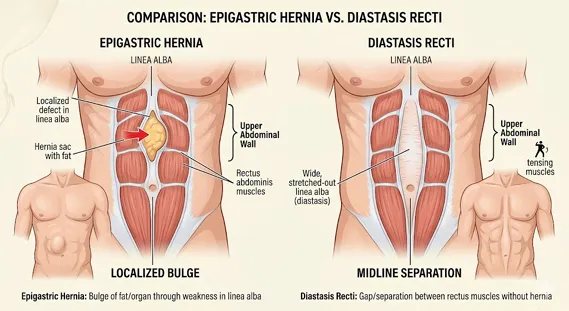
In our medical editorial work, we often see people delay assessment because they assume every abdominal bulge is “just muscle separation” or “just a hernia.” That guess can lead to the wrong exercises, missed warning signs, or unnecessary worry. A hernia involves tissue pushing through a defect in the abdominal wall. Diastasis recti is different. It is a widening or separation of the rectus abdominis muscles along the linea alba muscle separation in the midline, often linked to pregnancy, pressure changes, or weakened connective tissue.
This guide explains How to tell the difference between epigastric hernia and diastasis recti, what symptoms matter most, when both can happen together, and what next steps may help.
1. What is diastasis recti?
Diastasis recti is a separation of the left and right rectus abdominis muscles, the muscles many people call the “six-pack.” Instead of a true hole in the muscle wall, there is a stretch or widening of the connective tissue in the middle of the abdomen.
This is why diastasis recti is not usually considered a classic hernia.
It is common after pregnancy. It may also occur with obesity, repeated abdominal strain, chronic pressure inside the abdomen, or certain exercise patterns.
Common features of diastasis recti
- A ridge or dome-like bulge in the midline
- More noticeable when sitting up from lying down
- A feeling of core weakness
- Poor trunk support during movement
- Sometimes back pain or pelvic floor symptoms
- Usually little or no sharp pain
When reviewing postpartum cases, we often hear the same description: “My stomach tents up in the middle when I get out of bed.” That pattern strongly suggests diastasis recti rather than a small upper abdominal hernia.
Diastasis can also overlap with Postpartum abdominal bulge causes, especially when the abdominal wall and pelvic floor are still recovering after childbirth.
2. What is an epigastric hernia?
An epigastric hernia is a defect in the abdominal wall located between the breastbone and the belly button. Through that defect, fat or tissue can protrude outward and form a lump.
Unlike diastasis recti, a hernia is a true opening or weakness in the abdominal wall. That distinction shapes treatment. It also shapes risk.
Common causes of epigastric hernia
- Congenital weakness in the abdominal wall
- Heavy lifting
- Repeated straining
- Chronic cough
- Obesity
- Prior surgery or tissue weakness
Typical signs
- A localized lump in the upper abdomen
- Tenderness or pain over one spot
- Symptoms that worsen with coughing, lifting, or straining
- Sometimes a bulge that comes and goes
- Rarely, nausea or severe pain if tissue becomes trapped
This is why Stomach wall defect treatment is often very different from treatment for muscle separation. A true hernia may require surgical repair, while diastasis recti is often managed with rehab first.
3. Epigastric hernia vs diastasis recti symptoms: the most important differences
When people search for epigastric hernia vs diastasis recti symptoms, they are usually trying to answer one practical question: “Is this dangerous, or is this weakness?”
That is the right question.
Most studies and clinical guidelines agree on a few core differences. Pain, bulge shape, and exact location are among the most useful clues.
Quick comparison table
| Feature | Epigastric Hernia | Diastasis Recti |
|---|---|---|
| Basic problem | Tissue protrudes through a defect | Muscles separate along the midline |
| Usual location | Between sternum and belly button, often one spot | Midline of abdomen, often longer area |
| Bulge appearance | Localized lump | Ridge, dome, or trench-like gap |
| Pain | Often tender or painful | Usually painless, more weakness than pain |
| Risk level | May lead to incarceration or strangulation | No strangulation risk by itself |
| Diagnosis | Exam, sometimes ultrasound or CT | Exam, sometimes ultrasound |
| Common treatment | Observation or surgery | Physical therapy, exercise guidance, sometimes surgery |
A simple rule can help:
If the bulge is narrow, centered in one spot, and sore to touch, think hernia.
If the bulge is a longer ridge down the middle and appears with effort, think diastasis recti.
That said, self-diagnosis is imperfect. Some small hernias hide inside a wider abdominal wall weakness.
4. How to tell the difference between epigastric hernia and diastasis recti at home
People often ask about self-checking. A home check may offer clues, but it cannot replace an exam by a qualified clinician.
A simple self-observation approach
Try this gently:
- Lie on your back with knees bent.
- Place your fingers along the midline of your abdomen.
- Slowly lift your head and shoulders a little.
- Feel for either a long gap/ridge or one distinct lump.
What you may notice
More suggestive of diastasis recti
- A long midline bulge or “tenting”
- A soft gap you can feel between the abdominal muscles
- Weakness without focal tenderness
- Bulging that extends over several inches
More suggestive of epigastric hernia
- One specific bump in the upper stomach
- Soreness at one point
- Bulge that becomes more obvious with coughing
- A lump that may not follow the full midline pattern
This is one reason Abdominal gap exercise safety matters. If someone assumes a painful hernia is only diastasis and starts intense core work, symptoms may worsen.
If a bulge is painful, firm, suddenly larger, red, or associated with vomiting, urgent medical evaluation is important.
5. Why pain is often the biggest clue
Pain is not a perfect diagnostic tool, but it is often helpful.
Diastasis recti usually does not cause sharp, localized pain at the bulge itself. People may feel weakness, instability, poor posture, or lower back discomfort. The issue is often functional.
Epigastric hernia, in contrast, more often causes discomfort over a single area. That pain may flare with lifting, coughing, bowel straining, or exercise.
Example from clinical review
In our editorial review of patient stories, a common pattern appears:
- A postpartum patient notices a central ridge after sit-ups. There is no true tenderness. This often points toward diastasis.
- Another adult reports a small painful lump above the belly button that hurts when carrying groceries. That pattern is more concerning for epigastric hernia.
Still, symptoms can overlap. A large diastasis can coexist with a small hernia hidden inside it.
6. Can you have an epigastric hernia and diastasis recti at the same time?
Yes. Can you have an epigastric hernia and diastasis recti at the same time? Absolutely.
We see this question often, especially from postpartum patients and people who have had prior abdominal surgery. A stretched midline can exist alongside a true defect in the abdominal wall.
This overlap can make diagnosis harder.
A person may have:
- A general midline weakness
- A visible abdominal ridge
- One tender spot within that ridge
- Functional core problems plus hernia pain
That is why imaging may sometimes be useful. Ultrasound is often the first step. In more complex cases, CT imaging may clarify anatomy. According to the NHS, hernias can vary in size and symptoms, and examination is often enough, though imaging may help in uncertain cases.
This overlap also matters for surgery. A surgeon may repair the hernia while also discussing the broader abdominal wall issue.
7. Ventral hernia vs diastasis recti: where does epigastric hernia fit?
You may also come across the phrase Ventral hernia vs diastasis recti. A ventral hernia is a broad category that includes hernias on the front abdominal wall. An epigastric hernia is one type of ventral hernia.
So the relationship looks like this:
- Ventral hernia = umbrella term
- Epigastric hernia = ventral hernia in the upper midline
- Diastasis recti = not a true hernia, but a separation of the abdominal muscles
This distinction becomes important when people are researching Upper stomach hernia repair. A surgeon is repairing a defect when treating a hernia. In diastasis, the goal is usually restoring support and tension to the midline, often through rehab and only sometimes surgery.
If you are also reading about nearby upper digestive symptoms, some people confuse abdominal wall pain with reflux-related issues like Hiatal Hernia ICD 10, but these are very different conditions in different parts of the body.
8. How doctors confirm the diagnosis
The diagnosis usually starts with a physical examination. A clinician may ask you to lift your head, cough, or strain gently so the abdominal wall can be assessed in motion.
Tools that may be used
- Physical exam
- Ultrasound
- CT scan in selected cases
- Surgical evaluation if a hernia is suspected
Most consensus guidance supports imaging when the exam is unclear, symptoms are significant, or surgery is being considered. You can also find patient-friendly information through NICE guidance pathways and evidence summaries.
What doctors are looking for
- Is there a true defect or hole?
- Is the bulge focal or diffuse?
- Is tissue protruding?
- Is there tenderness?
- Is there risk of incarceration?
- How wide is the muscle separation?
This careful distinction helps avoid the wrong plan. A painful hernia should not be managed as if it were only exercise-related weakness.
9. Treatment: why management is different
This is the heart of the epigastric hernia vs diastasis recti conversation. Similar appearance does not mean similar treatment.
Diastasis recti management
In many cases, first-line care includes:
- Guided physical therapy
- Deep core retraining
- Breathing coordination
- Pelvic floor support
- Avoiding high-pressure movements early on
Helpful rehab may focus on safe, progressive loading rather than aggressive crunches. The question is not “How fast can I flatten my stomach?” It is “How can I restore support safely?”
The evidence around exact exercise protocols is still evolving, but many clinicians agree that targeted rehab may improve symptoms and function. The Cleveland Clinic explains that diastasis recti often responds to exercise guidance, though some severe cases may later need surgery.
Epigastric hernia treatment
For a true hernia, management may include:
- Monitoring if small and asymptomatic
- Weight management and strain reduction
- Surgical repair if painful, enlarging, or higher risk
Surgery may be open, laparoscopic, or robotic depending on size, anatomy, and surgeon judgment. In 2025–2026 practice trends, minimally invasive repair remains increasingly common in selected patients because it may reduce recovery time.
That does not mean every hernia needs immediate surgery. But persistent pain, worsening size, or signs of trapped tissue are stronger reasons for repair.

10. When to seek urgent care
Some symptoms should never be brushed aside.
Seek urgent medical attention if you have:
- Sudden severe abdominal pain
- A bulge that becomes hard or cannot be pushed back
- Redness over the lump
- Vomiting
- Fever
- Bowel obstruction symptoms
These can suggest hernia complications, not simple diastasis recti.
This point is especially important for readers also exploring other abdominal conditions such as gastric cancer, abdominal wall pain causes, or postpartum core weakness treatment. Not every stomach-area symptom comes from the same source.
Frequently Asked Questions
1. What are the main epigastric hernia vs diastasis recti symptoms?
The main difference is that hernias often cause a localized, sometimes painful lump, while diastasis recti usually causes a midline ridge or gap with weakness rather than sharp pain.
2. How to tell the difference between epigastric hernia and diastasis recti?
Look at the pattern. A single tender lump in the upper abdomen suggests hernia. A longer central bulge or gap, especially when sitting up, suggests diastasis recti. A clinician or ultrasound can confirm it.
3. Can you have an epigastric hernia and diastasis recti at the same time?
Yes. This can happen, particularly after pregnancy, weight changes, or prior abdominal surgery. One condition does not rule out the other.
4. Is diastasis recti dangerous?
Diastasis recti itself is usually not dangerous in the way a hernia can be. It does not typically carry a strangulation risk. But it can contribute to weakness, instability, and quality-of-life issues.
5. Does every epigastric hernia need surgery?
Not always. Small, asymptomatic hernias may be observed. Painful or enlarging hernias are more likely to need Upper stomach hernia repair after surgical assessment.
6. Are exercises safe if I am not sure what my bulge is?
Not always. Abdominal gap exercise safety depends on the correct diagnosis. If the bulge is painful or focal, get assessed before starting strenuous core work.
Conclusion
The difference between epigastric hernia vs diastasis recti comes down to structure, symptoms, and risk. A hernia is a true defect in the abdominal wall, often presenting as a localized upper abdominal lump that may hurt and sometimes needs surgery. Diastasis recti is a midline separation of the abdominal muscles, more often tied to weakness, posture changes, and functional recovery than emergency risk.
If you are trying to sort out epigastric hernia vs diastasis recti symptoms, focus on three clues: pain, exact bulge location, and whether the bulge feels like one lump or a long ridge. If there is uncertainty, imaging and a clinical exam are the safest next steps.
We often remind readers of one simple principle: do not force a treatment plan before you know which condition you have. The right diagnosis can prevent unnecessary fear, avoid unsafe exercise choices, and guide you toward the care that actually fits. If your symptoms are persistent, painful, or changing, speak with a qualified clinician.
References
- NHS: hernia
- NICE: NICE
- Cleveland Clinic: diastasis recti
Pingback: What Is an Apron Belly? Causes, Risks & Treatment Options
Pingback: C-Section vs Vaginal Delivery Pain: Which Recovery Is Harder?