
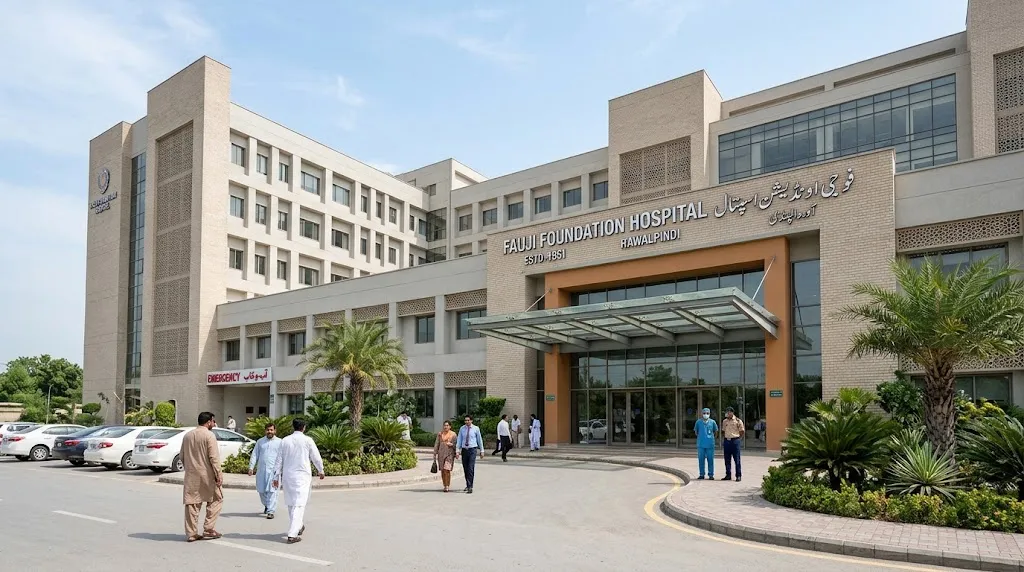
Fauji Foundation Hospital Pakistan: Locations, Services, Doctors & OPD Guide
Medical Disclaimer: This article, “Fauji Foundation Hospital Pakistan: Locations, Services, Doctors & OPD Guide,” is intended for general informational purposes only. Hospital locations, services, doctors, contact details, appointment procedures, eligibility criteria, and OPD timings may change without notice. Readers should verify the latest information directly with the relevant Fauji Foundation Hospital before visiting or making healthcare arrangements. This article does not constitute medical advice, diagnosis, or treatment recommendations. Always consult a qualified healthcare professional for individual medical concerns.
Written by: Dr. Sana Lodhi (General Medicine)
If you are trying to reach a Fauji Foundation Hospital in Pakistan, three things usually matter first: which city’s hospital is the right one, who is allowed to be treated there, and when the outpatient clinics are open. The foundation runs hospitals in several cities, and each one publishes its own contact details and schedules. Those schedules change by season and by specialist, which is why people often arrive to find the consultant they wanted is not in that day.
This guide covers the Rawalpindi, Lahore and Peshawar hospitals, based on their official pages and an affiliated medical college’s description of Peshawar. All figures were checked in early November 2026. Telephone numbers and timings do change, so treat everything here as a starting point and call before you travel.
Where Fauji Foundation Hospitals Are Located
The Fauji Foundation’s health system began with a TB hospital in 1954, according to the Wikipedia entry on Fauji Foundation Hospitals. It has since grown into a network. Publicly available lists of the foundation’s hospitals also name other cities, such as Multan, Jhelum, Sargodha, Mansehra and Faisalabad. Those are outside the scope of this guide, and I have not verified their services or timings.
| Hospital | Where it is | Main phone |
|---|---|---|
| Rawalpindi | Jhelum Road, near Defence Chowk | 051-5788150 (queries line lists 051-5788150-65) |
| Lahore | Near R.A. Bazar, reachable from Bhatta Chowk and DHA | 042-99333981 to 983, 042-37169454 |
| Peshawar | No. 1 Aziz Shaheed Road, Peshawar Cantt | 091-9212771, 091-9212774 |
The Rawalpindi hospital is described on its own website as the first and largest hospital in the foundation’s health care system. That makes it the best-documented of the three and the one most people mean when they search for the Fauji Foundation Hospital address.
Fauji Foundation Hospital Rawalpindi
The Jhelum Road campus is spread across several buildings rather than a single block. The official site lists an OPD complex, an emergency building, a separate CT and MRI building, a paediatrics building, a burn ward, a rehabilitation and physiotherapy centre, and an artificial limb centre. Knowing this helps on a first visit. “The hospital” is a campus, and the department you need may be in a different building from the gate you arrived at.
The hospital’s website states a capacity of 837 beds and 36 medical specialties. It also gives an average of about 1,562 OPD patients a day. These are the hospital’s own figures, not independently audited ones, but they give a sense of the crowds to expect. The site describes the emergency department as staffed around the clock, and it lists CT, MRI, mammography and laboratory services in chemical pathology, microbiology and haematology.
For general enquiries, the website gives 051-5788150 and the email [email protected].
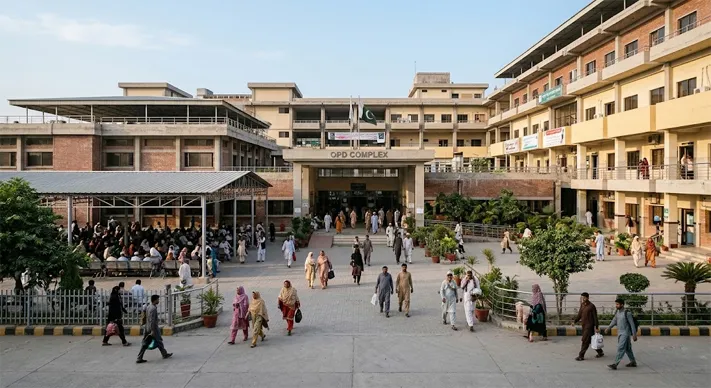
Departments you can expect
The hospital’s own pages list general medicine, general surgery, gynaecology and obstetrics, paediatrics and cardiology among its departments. Specialist clinics such as orthopaedics, neurology, urology, nephrology and plastic surgery run on fixed days, covered under the OPD section below. For women’s health services at any hospital, HealthPage’s gynaecology guides explain what the different clinics typically handle before you book.
Fauji Foundation Hospital Lahore
The Lahore hospital describes itself as located near R.A. Bazar, with easy access from Bhatta Chowk, DHA and R.A. Bazar. Its website lists telephone numbers 042-99333981 to 983 and 042-37169454. It also says the hospital has been affiliated with Shalamar Medical and Dental College since 2012 and trains house officers.
The hospital’s services list is more detailed than most hospital sites. Inpatient and full-service departments include emergency, medicine, surgery, gynaecology, paediatrics, neonatal and paediatric intensive care, orthopaedics, ENT, eye, dermatology, anaesthesia and physiotherapy. Diagnostics include a pathology laboratory, digital X-ray, ultrasound, ECG, exercise tolerance testing, echocardiography and endoscopy. Dialysis is also listed.
The detail that matters most is the label “OPD only”. Cardiology, psychiatry, pulmonology, urology and neurology appear as outpatient services, and nephrology and gastroenterology are also listed as OPD. In practice, a patient with a heart condition can be assessed in the cardiology clinic, but you should not assume a full cardiac inpatient programme exists. Anyone needing advanced cardiology care should ask directly what can be done on site and what would require referral.
The site also lists visiting specialists, for example in gynaecology, paediatrics and orthopaedic surgery. Visiting consultants come on set days, which makes calling ahead especially useful.
Fauji Foundation Hospital Peshawar
Peshawar is the hardest of the three to research, because the hospital has no website as detailed as the other two. What can be confirmed comes from two places. A UK government directory of English-speaking medical facilities in Pakistan, updated in August 2025, lists the hospital at No. 1 Aziz Shaheed Road, Peshawar Cantonment, with the numbers above and the email [email protected].
Pak International Medical College, to which the hospital is affiliated, describes it as a 200-bed hospital with medical, surgical, gynaecology, paediatrics, ophthalmology, radiology and psychiatry units.
One caution: at least one third-party booking directory gives a different road name and a different phone number for the Peshawar hospital. I could not tell which is current, so use the government-directory numbers, check them against the foundation’s own contact channels, and confirm the exact approach road when you call.
Doctors and Specialist Departments
Searching for a Fauji Foundation Hospital doctors list will return a mix of official pages and appointment directories, and the two are not equal. Rawalpindi’s official site has a “Find a Specialist” section and a doctor-by-doctor OPD timetable. Lahore’s site lists specialists by discipline, usually with the head of department marked and qualifications such as MBBS and FCPS shown. Both are better sources than a booking directory, whose consultation fees and availability can be out of date.
I have deliberately not reproduced individual names or fees here, because rosters change and a wrong name on a page is worse than none. A practical way to use the official lists is to note which department you need, then call to confirm the doctor works that day.
Orthopaedic patients should note that Rawalpindi runs orthopaedics on specific days for beneficiary and panel patients. If you are researching joint or bone problems before an appointment, HealthPage’s orthopaedics section can help you prepare questions.
Fauji Foundation Hospital OPD Timings and Appointments
OPD stands for outpatient department, meaning consultations and tests that do not require an overnight stay. At Rawalpindi, the official FAQ separates timings by patient category and by season:
| Patient category | Summer | Winter |
|---|---|---|
| Beneficiaries and panel patients | 7:30 am to 2:00 pm | 8:00 am to 2:30 pm |
| Private (CNE) patients | 7:30 am to 8:00 pm | 8:00 am to 8:30 pm |
Specialist clinics for beneficiaries and panel patients follow a weekly pattern on the hospital’s FAQ page:
- Monday: orthopaedics, neurology, chest, plastic surgery
- Tuesday: urology, nephrology
- Wednesday: orthopaedics, neurosurgery, liver
- Thursday: urology, neurology, orthopaedics, chest
- Friday: plastic surgery, diabetic clinic, nephrology
- Saturday: neurosurgery, neurology, liver
The same page lists vaccination on Mondays and Thursdays from 7:30 am to 2:00 pm.
The hospital’s site is not fully consistent. The home page’s doctor timetable shows some clinics ending at 12:30 pm rather than 2:30 pm, and a footer elsewhere shows 9:00 to 17:00 as opening hours. These may refer to different things, such as registration, specific clinics or administrative offices. That inconsistency is the strongest reason to phone first. If you are searching for Fauji Foundation Hospital OPD timings for Lahore or Peshawar, I could not find a published schedule for either that I could verify, so ask the reception.
On Fauji Foundation Hospital appointment booking: Rawalpindi’s website invites you to make an appointment, and third-party platforms also list doctors there. A booking through a third-party directory is not the same as a confirmation from the hospital, so treat it as a request until the hospital confirms.
Emergency Services and Diagnostic Facilities
OPD and emergency are different services, and the difference matters when a situation is urgent. OPD is scheduled and category-based, and it is not the place for sudden severe symptoms. Rawalpindi lists a round-the-clock emergency department, and Lahore’s service list shows an emergency department operating all hours. I did not find an equivalent statement for Peshawar, so call ahead if that is your nearest option. In a real emergency, go to the nearest facility that can treat you rather than waiting for a clinic slot.
On the diagnostic side, Rawalpindi lists CT, MRI, mammography and laboratory testing. Lahore lists digital X-ray, ultrasound, ECG, echocardiography, endoscopy and a pathology laboratory. Peshawar’s affiliated-college description mentions a radiology unit. Do not assume the three hospitals offer identical tests. An MRI done in Rawalpindi may not be available in Lahore or Peshawar.
Eligibility, Private Treatment and Required Documents
This section answers a question that causes real confusion: who can be treated, and on what terms? The Rawalpindi FAQ describes three groups, and I would not assume anything beyond them.
Beneficiaries are people entitled to the foundation’s services, based on the hospital’s own criteria. The FAQ lists these documents:
- Original and photocopy of the CNIC, plus the pension book and gratuity certificate.
- For children under 18, original and photocopy of the B-Form.
- For women over 18, the original CNIC and an unmarried certificate verified by a Union Council secretary, Cantonment Board member or Soldier Board secretary.
- For widows receiving a pension, the original and photocopy of the CNIC and pension book.
Private (CNE) patients are asked to bring their CNIC and any lab reports or prescriptions already advised by a consultant.
Panel patients need a referral letter that names the required OPD and is signed and stamped by the relevant organisation.
Eligibility has limits and exceptions. For example, the FAQ says Mujahid Force personnel who retired after 12 October 2012 may be treated themselves, but their families are not entitled. That one line shows why it is risky to assume a family member automatically qualifies. If you are unsure which category applies to you, call the hospital with your documents in hand and ask them to confirm. The same criteria may not apply at Lahore or Peshawar, so do not assume the Rawalpindi rules carry over.
Tips for Visiting and Preparing for an Appointment
Most wasted trips come from small gaps in preparation rather than anything dramatic. Before you travel:
- Confirm the doctor or clinic is running on the day you plan to come, and ask whether you need to arrive at a specific time for registration.
- Bring your original CNIC and the documents for your patient category. Carry photocopies where the hospital asks for them.
- Pack previous prescriptions, lab reports and imaging results in one folder, in date order.
- Ask about the consultation fee when you call, because published fees on third-party sites may be outdated.
- Allow extra time. A hospital that sees well over a thousand outpatients a day will have queues at registration, pharmacy and diagnostics.
If you want a general template for what to check before a hospital visit, HealthPage’s guide to planning a hospital visit walks through a similar checklist for a different hospital, and many of its points apply here too.
Frequently Asked Questions
Does Fauji Foundation Hospital treat private patients?
Rawalpindi’s FAQ describes a separate private (CNE) category with its own, longer OPD hours and a shorter document list. Lahore and Peshawar do not publish equivalent details that I could confirm, so ask directly.
Is emergency care available 24 hours a day?
Rawalpindi and Lahore both describe emergency services as running around the clock. For Peshawar, call to confirm. In a serious emergency, do not wait to confirm and go to the nearest capable facility.
How can I check whether my doctor is available?
Use the official hospital contact numbers, not only a third-party app. Specialist clinics run on fixed weekdays and some consultants visit on set days only.
Are the three hospitals the same?
No. They differ in bed numbers, available specialties and OPD structure. For instance, Lahore lists cardiology and neurology as OPD-only, while Rawalpindi publishes a wider set of specialist clinics.
Can I rely on third-party doctor directories?
They are useful for browsing, but fees, availability and phone numbers may be stale, and a directory booking is not the hospital’s confirmation.
Conclusion
A Fauji Foundation Hospital visit goes more smoothly when you treat the published information as a guide and confirm the details yourself. Pick the right city, work out whether you are a beneficiary, panel or private patient, check the season-specific OPD hours, and call to confirm your specialist is running that day. Bring original documents and previous reports.
For broader patient-friendly explainers while you prepare, HealthPage’s general health section is a good next stop. For the most current contact and timing information, rely on the hospitals themselves.
References
- Fauji Foundation Hospital Rawalpindi, “FAQs”, used for OPD timings, consultation days and eligibility documents. The official home page was used for bed capacity, specialties and campus layout.
- Fauji Foundation Hospital Lahore, official website, used for location, services and telephone numbers.
- Pak International Medical College, “Peshawar Institute of Medical Sciences”, used for Peshawar’s bed count and departments. UK Government, “List of English-speaking medical facilities in Pakistan”, used for Peshawar’s address and phone numbers.

Dr. Sana Lodhi is a qualified medical doctor (MBBS) with a strong commitment to patient care and evidence‑based medicine. With years of clinical experience and her current role at Liaquat University of Medical & Health Sciences (LUMHS), she brings trusted medical insights to readers, simplifying complex health topics into clear, practical guidance. Her passion lies in promoting preventive healthcare, empowering individuals to make informed decisions, and bridging the gap between medical knowledge and everyday wellness. At HealthyPost.co.uk, Dr. Lodhi shares expert perspectives on health, lifestyle, and medical awareness to help readers live healthier, more balanced lives.