

Steam Inhalation for Congestion: Natural Relief for a Stuffy Nose and Chest
When your nose is blocked and your chest feels heavy, a hot shower and a lungful of warm air is the most natural thing to reach for. Steam inhalation for congestion is one of the oldest home remedies there is, and plenty of people swear by it. The honest summary is this: warm, moist air can make a blocked nose feel more comfortable for a short while, but there is little solid evidence that it shortens a cold, and the traditional method of leaning over a bowl of boiling water causes serious burns every year. A steamy bathroom gives you most of the comfort without the danger.
This guide covers what steam can and can’t do, how to use it safely, which other natural measures are worth trying alongside it, and which symptoms mean it’s time to stop self-treating.
What steam inhalation actually means
Steam inhalation means breathing warm, humidified air in the hope that it eases a blocked or irritated airway. During a cold, the lining of the nose becomes swollen and inflamed, and the mucus it produces can turn thicker and stickier. Warm, moist air may make that mucus feel easier to shift and can soothe the dry, scratchy feeling that often comes with a stuffy nose.
The key point is that this is a comfort measure. Steam does not kill viruses, clear an infection from the lungs, or cure sinusitis. Anyone who tells you otherwise is claiming more than the research supports.
Does steam inhalation for congestion actually work?
The research is thin and mixed. A Cochrane review of heated, humidified air for the common cold found it uncertain whether the treatment gives symptom relief. Two small studies pointed to a benefit under one type of statistical analysis, while a second analysis showed no significant difference. The reviewers graded the evidence as low quality and concluded that it showed neither clear benefit nor harm. One detail is worth knowing: every trial in the review used a specialised heated-air device, not a kettle or a shower, so the findings don’t map neatly onto what people do at home.
Official advice sits in a slightly awkward place. The NHS common cold guidance suggests breathing in steam to ease a blocked nose and gives the example of sitting in the bathroom with a hot shower running. The CDC also lists steam among the ways to feel better while a cold runs its course. Meanwhile, burns specialists at the Northern Regional Burn Centre in Newcastle have noted that, although steam is commonly used for nasal congestion, there is little evidence to support its effectiveness.
Put together, a fair reading is that steam may temporarily ease a stuffy nose for some people, probably won’t change how long the illness lasts, and isn’t worth risking a scald for.
The benefits of steam for a stuffy nose
Even without strong trial evidence, there are sensible reasons why people feel better after a steamy shower.
- Moisture for irritated passages. Cold air, central heating and a blocked nose all dry out the nasal lining. Humid air counteracts some of that.
- Easier mucus movement. Thick secretions can feel less stubborn in warm, moist air, which makes blowing your nose less of a struggle.
- Relief from a scratchy throat. Mouth-breathing through a blocked nose dries the throat, and damp air takes the edge off.
- A moment of rest. Standing in a warm bathroom when you feel wretched is soothing in its own right, and rest matters when you’re ill.
None of these effects amount to treating the infection. They’re about how you feel in the hour after, and the benefit usually fades once you step out into cooler, drier air.
Can steam help with chest congestion?
“Chest congestion” means different things to different people. It can describe a wet cough that won’t quite clear, a heavy or tight feeling, mucus that has settled after a cold, or the wheezy tickle of a chest cold (acute bronchitis). Sometimes it’s something else entirely. A good deal of what feels like chest congestion is actually post-nasal drip, where mucus runs down the back of the throat and triggers coughing.
For the milder end of that range, a steamy bathroom or a humidified bedroom may make secretions feel less irritating. What steam can’t do is reach into the lungs and remove an infection. It is not a treatment for pneumonia, an asthma attack or any serious lower-respiratory illness. If your chest symptoms involve real difficulty breathing, steam is not the answer, and the warning signs later in this article apply.
How to use steam safely
The shower method
For an adult with an ordinary cold, this is the lowest-risk approach:
- Run a comfortably warm shower, hot enough to produce steam but not so hot that it scalds.
- Let the bathroom fill with mist, and keep the door closed for a few minutes.
- Sit or stand a safe distance from the water and breathe normally, through the nose if you can.
- Stay for as long as it feels comfortable, then step out before you feel light-headed or overheated.
- Drink a glass of water afterwards, since hot environments can leave you a bit dehydrated.
Take care on slippery tiles, and don’t lock the door if you feel unsteady.

Why to skip the bowl and towel
Safety warning: Leaning over a bowl of boiling water with a towel over your head is the method most often linked to burns. A moment’s slip can tip the bowl onto your face, chest or lap.
Burns specialists in the NHS report seeing serious scald injuries each winter, often affecting the face, chest, abdomen and legs, including in very young children. Their advice is to avoid bowls of boiling water and to use a steamy bathroom instead. The NHS itself says that children should not breathe in steam from a bowl of hot water because of the scalding risk.
It’s worth knowing that CDC guidance still lists steam from a bowl of hot water alongside the shower. If you read that and the NHS advice side by side, the sensible resolution is to take the safer option. A shower gives you the same warm, humid air without a container of near-boiling water balanced on your knees.
Should you add oils, herbs or menthol to the water?
Plain warm moisture is all the basic approach needs, and there’s little reason to add anything. Essential oils, menthol products and herbal mixtures can irritate the nose and airways, especially if you already have sensitive or inflamed passages, and they can be a problem for children and for people with asthma or allergies. Hot liquid with oils on top also adds a new hazard if it spills. Keeping things simple is both safer and better supported by the evidence, because the research that exists is about warm moisture alone.
How to relieve chest congestion naturally
Steam is only one tool, and it’s probably not the strongest. These measures are supportive: they help you feel better while your body does the recovering.
Fluids. Staying well hydrated helps keep mucus from drying and thickening. Water, broth and warm drinks all count.
Warm drinks. The NHS suggests a hot lemon and honey drink to soothe a sore throat. If you like variety, a roundup of soothing teas for a sore throat offers some options. Don’t give hot drinks to small children.
Honey. The CDC says honey can relieve cough in adults and children aged one year and older. Babies under 12 months should never be given honey.
Rest. It sounds dull, but sleep and downtime are what actually carry you through a viral illness.
Raised head at night. Sleeping with an extra pillow may stop mucus pooling and make night-time coughing less frequent.
A clean humidifier or cool-mist vaporiser. These add moisture to dry indoor air, and the CDC lists them among home measures for colds. The word “clean” matters. A neglected humidifier can spread mould and bacteria into the air you breathe, so empty, rinse and dry it regularly according to the maker’s instructions, and don’t let your room become damp.
None of these is a cure. Together, though, they make a sensible, low-risk routine.
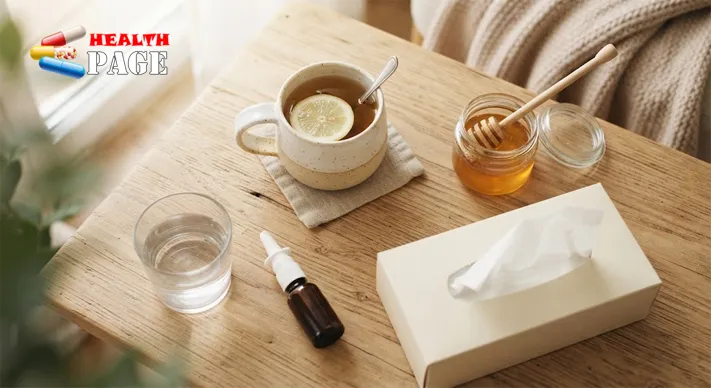
Home remedies for blocked nose and cough
Think of a typical evening with a cold. A warm shower before bed loosens things up for a while. Saline drops or spray afterwards moisten the nasal lining. A glass of water and a spoonful of honey in a warm drink settle the cough. A propped-up pillow and a humidifier in the bedroom do the rest overnight. That combination is more useful than any single remedy.
A few details are worth getting right:
- Saline spray or drops are a simple non-drug option that moistens the nose and helps thin mucus. The CDC lists them for adults and children, with a rubber suction bulb for babies and toddlers.
- Saline rinses (a neti pot or squeeze bottle) physically flush mucus, but they are not the same thing as steam. They must be made with distilled, sterile, or previously boiled and cooled water. Untreated tap water can carry organisms that shouldn’t go up your nose.
- Throat lozenges or cough drops can soothe a scratchy throat, though the CDC advises against giving them to children under four, and it’s worth reading about how many cough drops are too many before treating them as harmless sweets.
- Over-the-counter medicines are a decision for you and your pharmacist, particularly if you take other medicines or have a long-term condition. The NHS notes that some cough and cold medicines aren’t suitable for babies, children or pregnant women, and the CDC advises against them for children under six.
Steam therapy for respiratory relief: where it fits
“Steam therapy” is a loose term for exposure to warm, humidified air. It’s a reasonable short-term comfort measure when symptoms centre on nasal stuffiness, dry nasal passages, thick mucus, throat irritation or a cold-related cough. It shouldn’t be treated as a substitute for medical care when someone has significant breathing difficulty or a diagnosed respiratory disease.
That distinction matters most for people with asthma or other chronic lung conditions. Some find that steamy or very humid air irritates their airways instead of relaxing them. If that sounds like you, ask your doctor or asthma nurse before making steam part of your routine, and never use it in place of a prescribed inhaler during a flare-up.
Steam vs humidifier vs saline: which is which?
These options solve slightly different problems, which is why none of them is automatically “better”.
| Method | Main purpose | Worth knowing |
|---|---|---|
| Warm shower or steamy bathroom | Short burst of moist air and comfort | Keep the water comfortably warm; avoid prolonged, very hot steam |
| Cool-mist humidifier | Adds ongoing moisture to dry air | Needs regular cleaning; avoid over-humidifying |
| Saline nasal spray or drops | Moistens and loosens mucus in the nose | Simple, non-drug, suitable for repeated use |
| Saline nasal rinse | Flushes mucus from nasal passages | Use only distilled, sterile or boiled-and-cooled water |
| Fluids | Keeps mucus from thickening | Useful throughout any respiratory illness |
A shower gives temporary steam, a humidifier works in the background for hours, and saline works directly on the nasal lining. Many people end up using two or three together.
Who should take extra care
Some groups are better off avoiding steam beyond a supervised, steamy bathroom, or checking with a clinician first:
- Young children, who are at greatest risk of scalds. Never use a bowl of hot water. If you use a steamy bathroom, stay with them throughout.
- Older adults, who may have thinner skin, slower reactions and a higher risk of falls in a hot, wet bathroom.
- People with reduced mobility, or anyone who could knock over a container of hot water.
- People with asthma or other chronic breathing conditions, for the reasons above.
- Anyone with unexplained breathing difficulty. That calls for medical advice, not a hot shower.
When steam isn’t enough
Congestion isn’t always a simple cold. Allergies, sinus problems, structural issues inside the nose and lower respiratory infections can all produce blocked-up symptoms, and steam will do little for most of them. If you want background on other possible causes, an overview of common nasal conditions is a good place to start.
Seek medical advice promptly if you notice:
- difficulty breathing, or fast breathing
- severe or worsening chest pain
- blue or grey lips or face
- confusion or unusual drowsiness
- coughing up blood
- signs of dehydration or severe weakness
- a fever lasting longer than four days, or one that is persistently high
- symptoms that improve and then return or worsen
- symptoms that haven’t improved after 10 days
- a wheeze or asthma flare that isn’t settling
The CDC points out that a viral illness can occasionally lead to a bacterial infection such as pneumonia, which needs antibiotics. Home steam is not a way to monitor or manage that risk. The same lists suggest seeking help sooner for babies, older adults and anyone with a weakened immune system or a long-term condition.
Frequently asked questions
Does steam inhalation help congestion?
It may ease the feeling of a blocked nose for a short while, but there’s no strong evidence that it changes how long a cold lasts or treats the underlying cause.
Is steam really good for a stuffy nose?
Warm, humid air can make a stuffy nose feel less dry and irritated, and it may help mucus move. The effect tends to be brief, and it varies from person to person.
Can steam clear chest congestion?
It might make mucus and a dry, irritated chest feel more comfortable, but it can’t clear an infection from the lungs. Persistent or worsening chest symptoms need a clinician’s assessment.
How often can I use steam?
No official schedule exists, so use common sense. A few minutes in a comfortably warm, steamy bathroom is sufficient. Avoid long sessions in very hot steam, and stop if you feel dizzy, short of breath or overheated.
Is steam inhalation safe for children?
Never use bowls of hot or boiling water with children. A steamy bathroom is the safer choice, but an adult must stay with the child throughout. If a child has laboured breathing, get medical help instead.
Is steam better than a humidifier?
Neither is better outright. A shower provides a quick burst of warmth, while a clean humidifier adds moisture steadily over hours. They suit different moments.
The bottom line on steam for a blocked nose and chest
Steam inhalation for congestion can offer a modest, temporary lift when your nose is blocked and your mucus feels thick, but it isn’t a proven cure and it won’t clear a chest infection. The safest way to use it is a warm, steamy bathroom, not a bowl of boiling water. Pair it with fluids, rest, saline nasal care and, where appropriate, a clean humidifier, and keep a close eye on symptoms that suggest something more than a cold. If breathing becomes difficult or symptoms drag on, let a doctor take over.
References
- Singh M, Singh M, Jaiswal N, Chauhan A. “Heated, humidified air for the common cold.” Cochrane Database of Systematic Reviews, 2017. PubMed: https://pubmed.ncbi.nlm.nih.gov/28849871/
- NHS. “Common cold: Treatment.” https://www.nhs.uk/conditions/common-cold/treatment/
- Newcastle Hospitals NHS Foundation Trust. “Burns warning: risks of steam inhalation.” https://newcastle-hospitals.nhs.uk/news/burns-warning-risks-of-steam-inhalation/
(CDC guidance on managing the common cold, https://www.cdc.gov/common-cold/treatment/, was also consulted for the home-care list, honey and age advice, and when to seek care.)

Dr. Sana Lodhi is a qualified medical doctor (MBBS) with a strong commitment to patient care and evidence‑based medicine. With years of clinical experience and her current role at Liaquat University of Medical & Health Sciences (LUMHS), she brings trusted medical insights to readers, simplifying complex health topics into clear, practical guidance. Her passion lies in promoting preventive healthcare, empowering individuals to make informed decisions, and bridging the gap between medical knowledge and everyday wellness. At HealthyPost.co.uk, Dr. Lodhi shares expert perspectives on health, lifestyle, and medical awareness to help readers live healthier, more balanced lives.