
How Do We Breathe? A Simple Guide to the Respiratory System
Medical Disclaimer: The information provided in “How Do We Breathe? A Simple Guide to the Respiratory System”, written by Dr. Sana Lodhi (General Medicine), is for general educational and informational purposes only and does not constitute medical advice, diagnosis, or treatment. Always consult a qualified healthcare professional with any questions you may have regarding a medical condition or health concerns, and never disregard professional medical advice or delay seeking it because of something you have read in this article. If you experience a medical emergency or sudden breathing difficulty, seek immediate emergency medical care.
How do we breathe? Muscles, chiefly the diaphragm, enlarge the chest so that air flows in through the nose or mouth and down into tiny air sacs in the lungs. There, oxygen passes into the blood while carbon dioxide passes out. At rest, a healthy adult repeats this about 12 to 20 times a minute, usually without a moment’s thought. This guide follows a single breath from the nostrils to the body’s cells and back. It also explains why the process keeps going while you sleep, talk, or concentrate on something else entirely.
What Is Breathing, and Why Does It Matter?
Breathing is the way the body takes in oxygen from the air and gets rid of carbon dioxide, a waste gas made when cells burn fuel for energy. The word is often used loosely, though, and it covers three distinct processes:
- Ventilation is the physical movement of air into and out of the lungs. This is what most people picture when they think of breathing.
- Gas exchange is the movement of oxygen and carbon dioxide between the air sacs and the blood, and between the blood and the body’s tissues.
- Cellular respiration is a chain of chemical reactions inside cells that uses oxygen to extract usable energy, in the form of a molecule called ATP, from nutrients. Most of this takes place in mitochondria, the small structures that act as the cell’s power plants.
The distinction matters because breathing alone does not deliver oxygen to a muscle or a brain cell. The lungs bring oxygen into the body, and the circulatory system carries it the rest of the way. If either one fails, the cells go short of oxygen regardless of how well the other is working.
The Respiratory System: Organs in the Order Air Meets Them
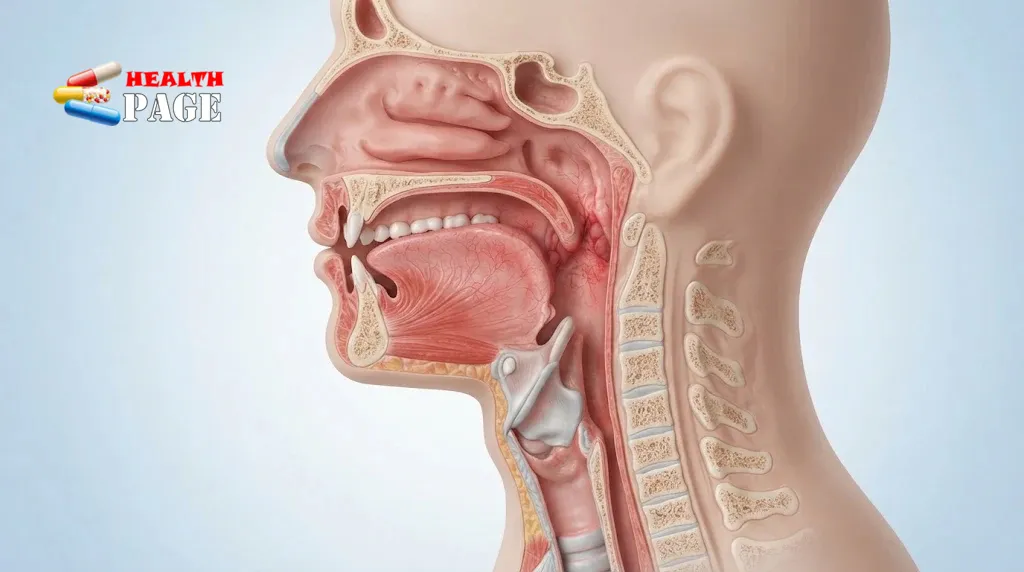
The respiratory system is the set of airways, lungs, and muscles that move air and exchange gases. Taking the structures in the order a breath passes through them makes the layout easy to follow.
| Structure | What it does |
|---|---|
| Nose and nasal cavity | Filters, warms, and moistens incoming air |
| Mouth | Offers a second route for air |
| Pharynx (throat) | Passage joining the nose and mouth to the larynx |
| Larynx (voice box) | Guards the lower airway and produces sound |
| Trachea (windpipe) | Carries air toward the lungs |
| Bronchi | Two main branches leading into the right and left lung |
| Bronchioles | Smaller branching tubes that spread air through the lungs |
| Alveoli | Tiny air sacs where gas exchange happens |
| Lungs | Hold the airways and the gas-exchange surfaces |
| Diaphragm | The main muscle of normal breathing |
A few details help the table make sense. The trachea is held open by C-shaped rings of cartilage, so it does not collapse when pressure changes. Inside the lungs, the bronchi divide again and again into ever finer bronchioles, which end in clusters of alveoli. According to the National Heart, Lung, and Blood Institute, the lungs hold about 150 million of these air sacs. Each is wrapped in a mesh of capillaries, the thinnest blood vessels in the body.
The lungs are enclosed by a double-layered membrane called the pleura. One layer covers the lungs themselves (the visceral pleura) and the other lines the chest wall (the parietal pleura). A thin film of fluid between them lets the lungs glide as the chest moves.
The throat is shared territory, since food and air both pass through it. When it becomes inflamed, as in pharyngitis, swallowing and breathing can both feel uncomfortable. The nose does a great deal of quiet work as well. Its lining conditions the air before it reaches the lungs, which is one reason common nasal conditions can affect how comfortable breathing feels.
How Does the Respiratory System Work?
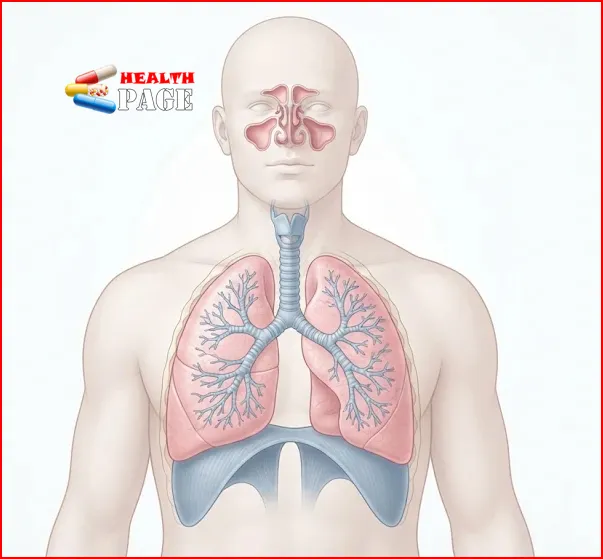
The system works only because several parts cooperate: the airways, the lungs, the breathing muscles, the nervous system, and the circulation. A single breath can be split into four stages.
- Air enters. Air travels through the nose or mouth, then the pharynx, larynx, and trachea, and down through the bronchi and bronchioles.
- Air reaches the alveoli. The finest airways end in the air sacs, whose thin walls offer a very large surface for gas exchange.
- Oxygen enters the blood. Oxygen crosses the alveolar wall into the capillaries and attaches to hemoglobin, a protein in red blood cells that carries most of the oxygen in blood.
- Oxygen reaches the tissues. The heart pumps the oxygen-rich blood around the body, and oxygen moves from the blood into cells. Carbon dioxide moves the opposite way, into the blood, and is carried back to the lungs.
That last stage is why the respiratory system cannot be understood without the heart. If you want to see what happens on the circulation side, this walk-through of how blood flows through the heart picks up where the lungs leave off.
How Do We Breathe In? Understanding Inhalation
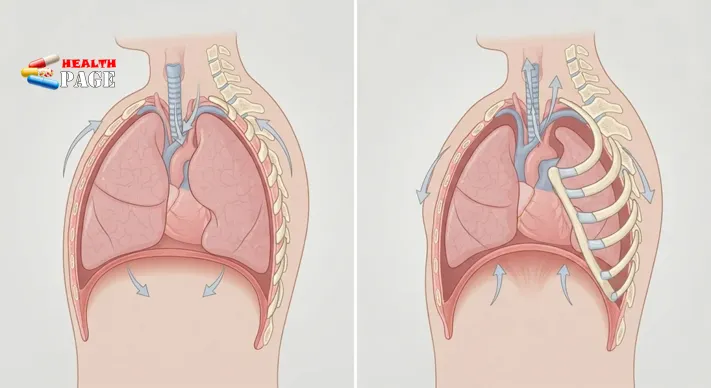
Inhalation, or inspiration, draws air into the lungs by making the chest cavity larger. Nothing inside the lungs pulls the air in. The lungs have no muscles of their own, and the work is done by the surrounding muscles, as the NHLBI’s explanation of what breathing does for the body describes.
The sequence runs like this:
- The diaphragm contracts and flattens, moving downward.
- The external intercostal muscles between the ribs contract, lifting the rib cage up and out.
- The chest cavity gets bigger, and pressure inside the lungs falls slightly below the pressure of the air outside.
- Air flows in through the airways to equalize that difference.
The lungs follow the chest wall because the two pleural layers cling together through that thin film of fluid. The effect is similar to a syringe: pull the plunger back and the space inside grows, so air rushes in to fill it.
How Do We Breathe Out? Understanding Exhalation
During quiet breathing, exhalation takes almost no effort. The diaphragm relaxes and rises back into its dome shape, the intercostal muscles relax, and the rib cage drops. The chest cavity shrinks, the elastic lung tissue recoils, and the pressure inside the lungs rises above the outside pressure. Air then flows out through the bronchi, trachea, and nose or mouth.
Forceful breathing is different. When you cough, blow out candles, or run uphill, the abdominal muscles and the internal intercostal muscles step in and push the air out faster.
One common misconception is worth clearing up. Exhaled air is not “used-up” air with all the oxygen removed. The body absorbs only a fraction of the oxygen it inhales, so the air coming out still carries a good deal of it, which is why mouth-to-mouth resuscitation can work. What changes is the mixture:
| Feature | Inhaled air | Exhaled air |
|---|---|---|
| Oxygen | About 21% | About 16% |
| Carbon dioxide | About 0.04% | About 4% |
| Nitrogen | About 78% | About 78% |
| Water vapor | Varies | Usually higher |
| Temperature | Matches surroundings | Warm and humid |
These figures are approximations for ordinary air and typical exhaled air, and they shift with breathing pattern and physical condition. The water vapor is why your breath fogs a cold window.
How Do the Lungs Exchange Oxygen and Carbon Dioxide?
Gas exchange happens almost entirely in the alveoli, and it relies on diffusion, the natural drift of a gas from where it is more concentrated to where it is less so. The inhaled air in the alveoli holds more oxygen than the blood arriving from the body, so oxygen moves into the blood. That blood holds more carbon dioxide than the alveolar air, so carbon dioxide moves the other way.
The alveoli are built for this. Their walls and the neighboring capillary walls are extremely thin, so gases need to travel only a tiny distance. Together the air sacs provide a very large surface area, and each is surrounded by a dense network of capillaries. Their moist lining helps gases dissolve and cross, and their elasticity lets them expand and spring back with every breath.
Once oxygen enters the blood, most of it binds to hemoglobin. The oxygen-rich blood travels through the pulmonary veins to the left side of the heart, which pumps it out to the rest of the body. The overall pattern is a loop: air in, oxygen to the blood, blood to the tissues, carbon dioxide back to the lungs, air out.
How Do We Breathe Out Carbon Dioxide?
Carbon dioxide is produced constantly as cells release energy from food. If it built up, it would make the blood too acidic and disturb the body’s chemistry, so the body clears it continuously. Getting it from the cells to the lungs takes several steps.
Carbon dioxide first diffuses from the tissues into nearby capillaries. In the blood it travels in three main forms, with percentages that are approximate and vary with physiological conditions:
- about 70% as bicarbonate ions, formed in a reaction that an enzyme called carbonic anhydrase speeds up inside red blood cells;
- roughly 20–23% attached to hemoglobin and other proteins;
- around 7–10% dissolved directly in the plasma.
When the blood reaches the lungs, the process reverses. Bicarbonate is converted back into carbon dioxide, which diffuses into the alveoli because its pressure there is lower than in the blood. The next exhalation carries it out through the airways.
It is easy to assume that one big breath out empties the body of carbon dioxide. It does not. Production never stops, and the lungs remove the gas gradually across repeated breaths. That steady rhythm is also why the body treats a rise in carbon dioxide as the main cue to breathe faster.
How Do We Breathe Without Thinking?
Breathing runs on its own because the brainstem, particularly the medulla oblongata and the pons, generates the basic rhythm. It sends signals down the spinal cord to the diaphragm and intercostal muscles, which contract and relax in a steady cycle. That cycle carries on whether you are watching television, solving a puzzle, or fast asleep.
How Does the Brain Know When to Adjust?
The body monitors its own chemistry with sensors called chemoreceptors. Central chemoreceptors in the brainstem respond mainly to changes in acidity linked to carbon dioxide levels. Peripheral chemoreceptors, found in the carotid bodies in the neck and the aortic bodies near the heart, detect shifts in oxygen, carbon dioxide, and acidity and report them to the brainstem.
When carbon dioxide rises, the respiratory centers generally increase the rate and depth of breathing. When it falls, breathing can slow or become shallower. This feedback explains something many people have noticed: the urge to breathe after holding your breath is driven largely by carbon dioxide building up rather than by oxygen running low.
Can We Take Control?
Yes, for a while. You can hold your breath, take a deep one, sing, speak, or blow on hot soup. Conscious control overrides the automatic system temporarily, but the automatic system keeps working in the background and resumes when your attention moves elsewhere.
How Do We Breathe When We Sleep?
It can seem puzzling that something so essential continues when we are unconscious. The answer is that the brainstem needs no conscious input. During sleep it keeps producing breathing signals, the diaphragm keeps contracting and relaxing, oxygen keeps entering the blood, and carbon dioxide keeps leaving. Breathing does not stop during normal sleep, though the pattern does change.
What Changes During Sleep?
Breathing may become slower and shallower in some sleep stages, and during REM sleep it can become more variable and irregular. The muscles that hold the upper airway open also relax somewhat. For most people this causes no trouble, and the chemoreceptors keep adjusting breathing in the background. Sleep affects the heart as well as the lungs, and this overview of how sleep affects heart rhythm covers that side of the story.
When Sleep Breathing Goes Wrong
In sleep apnoea, breathing repeatedly stops and starts during the night. In obstructive sleep apnoea, the most common type, the airway narrows or closes as the throat muscles relax, so airflow drops even though the body keeps trying to breathe. In central sleep apnoea, the brain temporarily fails to send the normal signals to the breathing muscles. The NHS lists symptoms such as breathing that stops and starts, gasping or snorting, waking often, and loud snoring. If these sound familiar, or you feel unusually tired by day, a GP can arrange testing.
How Does Breathing Change During Exercise?
Working muscles burn more fuel, so oxygen use and carbon dioxide production both climb. The brain responds by raising the rate and depth of breathing, and the heart beats faster and pumps more blood per minute so more oxygen reaches the muscles and more carbon dioxide returns to the lungs. During hard effort, accessory muscles in the neck and chest can join in, and the abdominal muscles help force air out. Climbing a flight of stairs is a small version of this: within seconds you are breathing deeper and faster without having decided to.
How Does the Respiratory System Protect Itself?
Every breath brings dust, pollen, microbes, and other particles with it, and the airways have several layers of defense:
- Nasal hairs and mucus trap larger particles before they go deeper.
- Mucus lining the airways catches smaller particles and microorganisms.
- Cilia, microscopic hair-like structures, sweep the mucus and what it has trapped up toward the throat, where it is swallowed or coughed out.
- Coughing and sneezing are reflexes that expel irritants from the lower and upper airways.
- Immune cells patrol the respiratory tract and fight infection.
These defenses sometimes become visible in everyday ways. Mucus that collects at the back of the throat is the familiar annoyance behind post-nasal drip, for example. Infections can also overwhelm the defenses. Influenza, which affects the airways and lungs, is a typical case, and what the flu feels like shows how quickly the whole system can be affected.
How Can We Keep the Respiratory System Healthy?
Sensible habits go a long way, and none of them require anything exotic:
- Avoid smoking and secondhand smoke.
- Limit exposure to air pollution where you can, and keep indoor spaces ventilated.
- Stay physically active in a way that suits your fitness and any medical conditions.
- Keep up with recommended vaccinations.
- Wash your hands regularly to reduce respiratory infections.
- Follow your treatment plan if you have a lung condition such as asthma.
- See a doctor about a cough that will not clear, wheezing, or breathlessness that is new or getting worse.
Be wary of claims that a particular food, supplement, breathing technique, or home remedy can “cleanse” the lungs or reverse lung damage. The evidence does not support such promises.
Frequently Asked Questions About Breathing
How many breaths do we take in a minute?
A healthy adult at rest typically breathes about 12 to 20 times a minute. Age, fitness, fever, and anxiety can all shift this, so it is a range rather than a fixed figure.
Do the lungs have muscles?
No. The diaphragm and the muscles between the ribs change the size of the chest cavity, and the lungs follow. The lungs’ own elasticity then helps push air out.
Why does breathing speed up during exercise?
Active muscles use more oxygen and release more carbon dioxide. Sensors detect the change, and the brainstem increases both the rate and depth of breathing to compensate.
What happens if we stop breathing?
Oxygen delivery to the body stops, and the brain is especially sensitive to the loss. Prolonged interruption can cause serious harm, so a person who is not breathing needs emergency help straight away.
Which part of the brain controls breathing?
The brainstem, mainly the medulla oblongata and the pons. The cerebral cortex can override it briefly when you choose to hold your breath or speak.
Final Thoughts
So, how do we breathe? Muscles change the shape of the chest, air flows along a branching network of tubes, and oxygen and carbon dioxide trade places across the thin walls of the alveoli. The heart and blood complete the journey, and the brainstem keeps the whole thing ticking along, awake or asleep. Understanding how the respiratory system fits together makes it easier to notice when something is off, such as a cough that lingers or breathlessness that seems out of proportion. If you notice either, it is worth getting checked rather than waiting it out.
References
- National Heart, Lung, and Blood Institute (NIH), “How the Lungs Work – The Respiratory System”: https://www.nhlbi.nih.gov/health/lungs/respiratory-system
- National Heart, Lung, and Blood Institute (NIH), “How the Lungs Work – What Breathing Does for the Body”: https://www.nhlbi.nih.gov/health/lungs/breathing-benefits
- NHS, “Obstructive sleep apnoea” (symptoms and treatment): https://www.nhs.uk/conditions/obstructive-sleep-apnoea/treatment/

Dr. Sana Lodhi is a qualified medical doctor (MBBS) with a strong commitment to patient care and evidence‑based medicine. With years of clinical experience and her current role at Liaquat University of Medical & Health Sciences (LUMHS), she brings trusted medical insights to readers, simplifying complex health topics into clear, practical guidance. Her passion lies in promoting preventive healthcare, empowering individuals to make informed decisions, and bridging the gap between medical knowledge and everyday wellness. At HealthyPost.co.uk, Dr. Lodhi shares expert perspectives on health, lifestyle, and medical awareness to help readers live healthier, more balanced lives.