

DX Codes ICD-10: What Diagnosis Codes Mean and How to Find Them
Medical Disclaimer: This article, “DX Codes ICD-10: What Diagnosis Codes Mean and How to Find Them,” is intended for informational and educational purposes only. It explains medical diagnosis coding and the ICD-10-CM classification system and should not be considered a substitute for professional medical advice, diagnosis, treatment, or qualified medical coding guidance.
ICD-10 diagnosis codes should be selected and interpreted according to appropriate clinical documentation and official coding guidelines. Readers should consult a qualified healthcare professional or certified medical coding specialist when clarification is needed. Always verify coding information against current official sources.
Article author: Dr. Akram Chang (Cardiovascular Medicine).
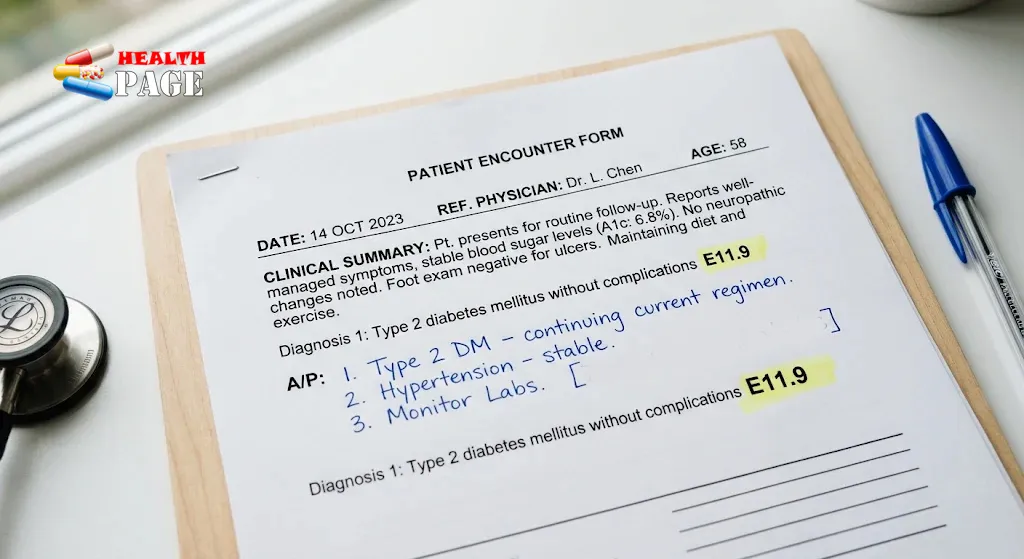
Open a patient portal, a visit summary, or an insurance explanation of benefits and you will often see a short string of letters and numbers next to a line marked “DX.” These dx codes icd 10 entries turn a clinician’s written diagnosis into a standard format that medical records, billing departments, and insurers can all read. A code such as E11.9 stands for a specific condition (type 2 diabetes mellitus without complications), and it takes about a minute to decode once you know where to look.
This guide explains what DX means, how ICD-10 diagnosis codes are built, and how the US version differs from the international one. It also walks through a diagnosis code lookup with the CDC’s free browser. It is written for patients reading their own paperwork and for newer billing and coding staff. A code only records a diagnosis that a clinician has already made. It cannot make one.
What Does DX Mean in Medical Terminology?
DX is shorthand for “diagnosis.” It sits alongside other clinical abbreviations such as Rx (prescription), Hx (history), and Sx (symptoms). A DX code is a standardized code that represents a documented disease, condition, symptom, injury, or other reason someone received care. That last category is broader than it sounds. A routine screening, a vaccination visit, or a follow-up after an injury can all carry a code even though the person is not newly ill.
Standardization is the whole point. A physician in Ohio and an insurer in Texas may describe the same condition in different words. A shared code lets both sides record it the same way, which supports medical documentation, claims processing, and health statistics.
What Are ICD-10 Diagnosis Codes?
ICD stands for International Classification of Diseases. ICD-10 is the tenth revision, published by the World Health Organization (WHO). In the United States, diagnoses are reported with a national adaptation called ICD-10-CM, where “CM” means clinical modification. US healthcare moved to it on October 1, 2015, and it now holds well over 70,000 codes.
According to the CDC’s ICD-10-CM page, the National Center for Health Statistics (NCHS) develops the clinical modification, and WHO authorized it to do so. Any changes have to stay within WHO’s established structure. The result is a system where the broad framework is international but the fine detail is American.
ICD-10 vs. ICD-10-CM vs. ICD-10-PCS
People often use these three terms as if they meant the same thing. They do not, and mixing them up is one of the more common sources of confusion on billing statements.
| System | Maintained by | What it is used for |
|---|---|---|
| ICD-10 | WHO | International disease classification; in the US, coding causes of death |
| ICD-10-CM | CDC’s NCHS | Diagnosis codes in US healthcare settings |
| ICD-10-PCS | CMS | Procedure codes for inpatient hospital stays |
Outpatient and office procedures are usually reported with a different system altogether, CPT and HCPCS codes. So a single claim can carry a diagnosis code explaining why care happened and a procedure code describing what was done.
How ICD-10-CM Codes Are Structured
ICD-10-CM codes run from three to seven characters. The first is always a letter, the second is a number, and the remaining characters can be letters or numbers. A decimal point follows the third character. Each added character narrows the description.
Take E11.9 as a simple case. The letter E places the code in the chapter for endocrine, nutritional, and metabolic diseases. E11 identifies type 2 diabetes mellitus. The 9 after the decimal means “without complications.” Change that final character and the meaning shifts to a specific complication.
Injury codes show how much detail the later characters can carry. S52.501A describes an unspecified fracture of the lower end of the right radius (a forearm bone), and the final A marks an initial encounter for a closed fracture. That seventh character is required for many injury codes, and it tells the reader whether care is active treatment, a follow-up visit, or a later complication. When a code needs a seventh character but has fewer than six before it, a placeholder “X” fills the gap.
This is also why a three-character category is often not enough on its own. Many categories act as headings, and a claim needs the full code beneath them. The abbreviated I71.4, for instance, was once a complete code, but the abdominal aortic aneurysm codes now require a fifth character that records the aneurysm’s documented location.
Primary vs. Secondary Diagnosis Codes
Most visits involve more than one condition, so claims and records usually list several codes in a deliberate order. The terms below come up constantly, and their meanings shift a little by setting.
| Term | Plain meaning |
|---|---|
| DX | Short for diagnosis |
| Primary or principal diagnosis | The main condition behind the encounter or admission |
| Secondary diagnosis | An additional documented condition relevant to the encounter |
| Billable code | A complete code, with all required characters, that can be reported on a claim |
Official coding guidelines use slightly different language by setting. Hospital inpatient stays use “principal diagnosis,” meaning the condition established after study to be chiefly responsible for the admission. Outpatient visits use “first-listed diagnosis,” which is the main reason for that visit. Which condition goes first depends on what the clinician documented and on the sequencing rules, not on which one sounds most serious.
Specificity matters at the billing level too. At a follow-up appointment, how high cholesterol is coded depends on whether the note documents pure hypercholesterolemia or only the broader term hyperlipidemia, and the two map to different codes.
Mental Health DX Codes ICD-10
Mental, behavioral, and neurodevelopmental disorders sit in Chapter 5 of ICD-10-CM, which covers codes F01 through F99. The chapter is large, with more than a thousand individual codes. Broad groups include depressive disorders, anxiety disorders, bipolar disorders, schizophrenia spectrum disorders, attention-deficit/hyperactivity disorder (ADHD), and substance-related disorders.
Two examples show how the same family splits into specifics. F41.1 is generalized anxiety disorder, and F32.A is depression, unspecified. The “unspecified” wording reflects limited documentation on a given claim. It does not describe severity.
A clinician makes a mental health diagnosis, usually by applying established diagnostic criteria through assessment and history. The code then reflects what has been documented. A list of F-codes is not a checklist for self-assessment, and a code appearing on a claim does not by itself show how a person is doing or what care they received. Anyone worried about their own mental health should speak with a licensed professional rather than working backward from a code.
How to Do a Diagnosis Code Lookup Using the CDC Browser
For most readers this is the most practical step. The CDC offers a free ICD-10-CM Browser Tool where you can search by code or by diagnostic term. A careful lookup follows a set order:
- Start with the diagnosis or term your clinician actually documented, not a symptom you searched online.
- Open the CDC browser and enter the term or a known code.
- Choose the fiscal-year release that matches the date of service (more on this below).
- Check the Alphabetic Index, which points you to a possible code.
- Verify that code in the Tabular List, the main listing of codes in chapter order.
- Read the notes in the Tabular List: inclusion terms, exclusions, “code first” instructions, and any rules about extra characters.
- Confirm the code is complete. If characters are missing, it is a heading and not a reportable code.
Step 5 is the one people skip. The Index can suggest a code, but only the Tabular List confirms whether it is valid and what restrictions apply. If you search “type 2 diabetes,” for example, the Index leads you toward the E11 family, and the Tabular List then shows the many options within it.
The year matters because the code set changes every October. The FY 2027 ICD-10-CM set took effect on October 1, 2026, and applies to encounters through September 30, 2027, according to the CMS ICD-10 resource page. A visit on September 15, 2026 falls under the previous year’s codes, even though you are looking it up today. Codes can be added, revised, or deleted between years, so an old list may mislead you.
Why DX Codes ICD-10 Look Different on a Bill Than in Your Chart
Patients are often surprised when the wording next to a code does not match how their doctor talked about the problem. That is normal. Coders translate clinical documentation into the closest official description, and the official wording can sound stiffer or more technical than conversation. A condition you call “a weak back” and a physician writes up as lumbar strain will appear under the formal term.
Symptom and diagnosis codes can also differ in the same record. The palpitations code R00.2 is an example of a symptom code: it is used while the cause is still being worked out and is typically replaced by a confirmed diagnosis if one is established. Seeing a symptom code on an early claim does not mean the underlying problem was ignored.
Diagnosis codes also sit beside separate codes for services. A claim for a heart ultrasound pairs a diagnosis code, which gives the reason for the test, with a procedure code, which names the test itself, such as CPT code 93306 for an echocardiogram. If the two do not fit together logically, an insurer may question the claim.
Patients cannot pick or change their own diagnosis codes. Codes must come from clinician documentation and follow official guidelines. If a code looks wrong, the better route is to ask the provider’s billing office to review it against the record. Under HIPAA, you can also ask for an amendment to health information you believe is inaccurate, though the provider decides whether to accept it.
Common Mistakes and Misconceptions
Several errors come up repeatedly with diagnosis codes:
- Treating a code as a diagnosis. A code records a condition a clinician documented. It does not diagnose anything.
- Using an outdated list. A code that was valid last year may now be a heading, revised, or deleted.
- Stopping at the Alphabetic Index. The Tabular List is where a code is confirmed.
- Assuming “unspecified” means serious or careless. It generally means the documentation did not support a more specific option.
- Reading a symptom code as a disease. Symptom codes describe what was observed, not a confirmed cause.
- Judging care quality from a code. A code alone cannot show whether someone received appropriate treatment. Incomplete documentation can slow a claim down, but that is an administrative problem and not a clinical verdict.
Frequently Asked Questions
What does DX mean on a medical bill?
It labels the diagnosis code or codes that explain why a service was provided. You may see several, because insurers want each reason for care recorded. A standard professional claim form has room for up to 12 diagnosis codes.
Can I look up my own DX code?
Yes. The CDC browser is public, and reading what a code means can help you ask better questions at your next appointment. It will not tell you whether your diagnosis is correct, and it should not replace a conversation with your clinician.
Is ICD-10-CM the same as ICD-10?
No. ICD-10 is the WHO’s international classification. ICD-10-CM is the US adaptation used for diagnosis coding in American healthcare, and it adds detail the international version lacks.
Do diagnosis codes change?
Yes, once a year. A new set takes effect each October 1 and applies until the following September 30, so the date of service decides which release is correct.
Why do I see a code for something I was only screened for?
Screening and preventive visits have their own codes, because the claim is describing the reason for the encounter. It is not stating that you have the condition being screened for.
Conclusion
Dx codes icd 10 are best understood as a shared language and not a verdict. Each code compresses a documented condition into a standard format, and the characters that follow the decimal point carry the detail. When one appears on your paperwork, search the clinician’s actual wording in the CDC browser, confirm the result in the Tabular List, and match it to the right fiscal year. If something still looks off, a call to the billing office or your provider is a sensible next step. For related coding explainers, HealthPage’s cardiology articles cover several commonly searched diagnosis codes.
Medical disclaimer: This article is for general education and is not medical, legal, or professional coding advice. A qualified healthcare professional establishes and documents diagnoses, and a certified coder or your payer should confirm codes for any specific claim.
References
- CDC, National Center for Health Statistics. ICD-10-CM. https://www.cdc.gov/nchs/icd/icd-10-cm/index.html
- CDC. ICD-10-CM Browser Tool. https://icd10cmtool.cdc.gov/
- Centers for Medicare & Medicaid Services. ICD-10 Codes. https://www.cms.gov/medicare/coding-billing/icd-10-codes

Dr. Akram Chang is a veteran Cardiac Specialist with extensive clinical experience serving at the historic
Gulab Devi Teaching Hospital in Lahore.
Specializing in clinical cardiology, myocardial preservation, and preventative cardiovascular health, he dedicates his medical career to both critical inpatient care and global public health literacy.
As a core panelist on the HealthPage Medical Review Board,
Dr. Chang provides rigorous clinical oversight, expert fact-checking, and medical verification for our thoracic and circulatory care resources. His analytical oversight ensures that complex hospital diagnostics are translated into safe, actionable, and strictly evidence-based lifestyle habits.
✉ Professional Inquiries:
[email protected]