
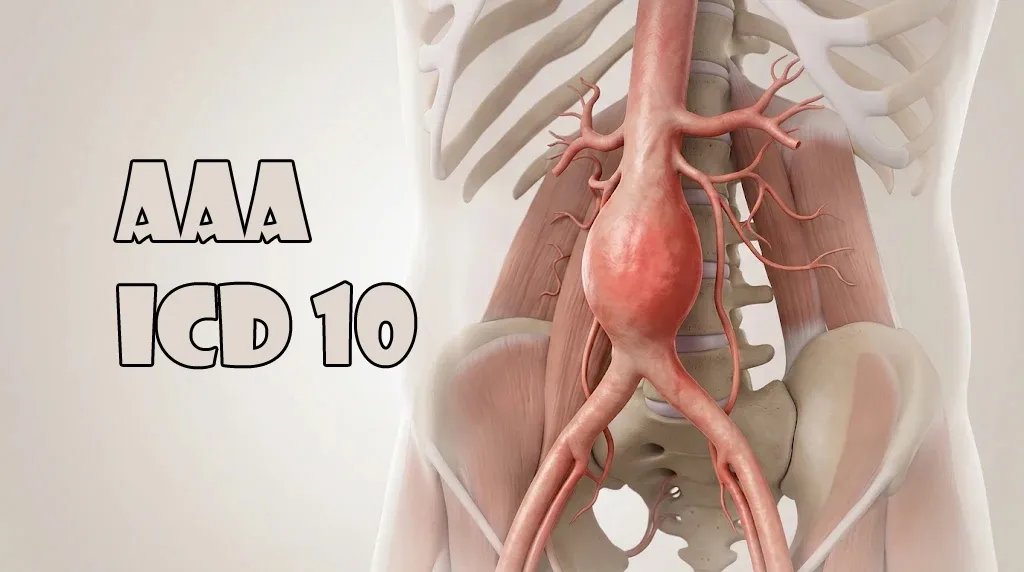
AAA ICD-10 Code: Abdominal Aortic Aneurysm Codes Explained
Medical Disclaimer: The article titled “AAA ICD-10 Code: Abdominal Aortic Aneurysm Codes Explained,” written by Dr. Akram Chang (Cardiovascular Medicine), is provided for informational and educational purposes only. It should not be construed as professional medical advice, diagnosis, or treatment. Always seek the advice of your physician or other qualified health provider with any questions you may have regarding a medical condition.
If you need the aaa icd 10 code, there is no longer a single answer. Since October 1, 2022, the US ICD-10-CM system has separated abdominal aortic aneurysm (AAA), an abnormal bulge in the part of the aorta that runs through the abdomen, into eight billable codes. The right one depends on two questions: has the aneurysm ruptured, and where along the aorta does it sit?
A third question causes more claim errors than either of those: is the encounter about an aneurysm someone already has, or a screening test for someone who may not? Those use entirely different codes. This guide covers all three, based on the FY 2027 code set, which applies to encounters from October 1, 2026 through September 30, 2027.
Quick-reference table: AAA ICD-10-CM codes
Find the documented location in the left column, then read across for rupture status.
| Documented location | Without rupture | Ruptured |
|---|---|---|
| Unspecified | I71.40 | I71.30 |
| Pararenal | I71.41 | I71.31 |
| Juxtarenal | I71.42 | I71.32 |
| Infrarenal | I71.43 | I71.33 |
The three-character parents, I71.3 (ruptured) and I71.4 (without rupture), are header categories and are not billable on their own. You always need the fifth character. Because the annual files are updated each October, confirm descriptions in the current CMS and CDC ICD-10-CM release files before relying on any lookup page, including this one.
ICD-10-CM is the US clinical modification. The WHO’s ICD-10, used in many other countries, stops at four characters here (I71.3 and I71.4), so the five-character codes above are specific to the US system.
Abdominal aortic aneurysm ICD 10: the unruptured codes
Most people who have an AAA are never ruptured, and most aneurysms are found while still intact, often on imaging done for another reason. These cases fall under I71.4-:
- I71.40: Abdominal aortic aneurysm, without rupture, unspecified
- I71.41: Pararenal abdominal aortic aneurysm, without rupture
- I71.42: Juxtarenal abdominal aortic aneurysm, without rupture
- I71.43: Infrarenal abdominal aortic aneurysm, without rupture
A common shortcut is to assign I71.40 to any unruptured AAA. That is only correct when the record doesn’t state where the aneurysm is. If a vascular surgeon’s note says “infrarenal AAA, 4.8 cm,” then I71.43 is the more accurate choice, and I71.40 undersells what the record supports.
Here is a practical example. A radiology report describes an aneurysm “beginning just below the renal arteries.” The referring physician’s note says only “AAA, under surveillance.” Code selection generally rests on the treating provider’s documentation, so a coder may need to query the provider before choosing between I71.40 and I71.43, rather than inferring the location from the imaging alone. The same principle drives other cardiology codes. HealthPage’s palpitations coding and documentation guidelines show how much a code’s accuracy depends on what the clinician actually recorded.
One more note: ICD-10-CM includes a “code first” instruction under the aortic aneurysm category for syphilitic aortic aneurysm (A52.01) and traumatic aortic aneurysm (S25.09, S35.09), according to AAPC’s coverage of the 2023 changes. If the cause is documented, the underlying condition is sequenced first.
Infrarenal AAA ICD 10: I71.43 and the anatomy behind it
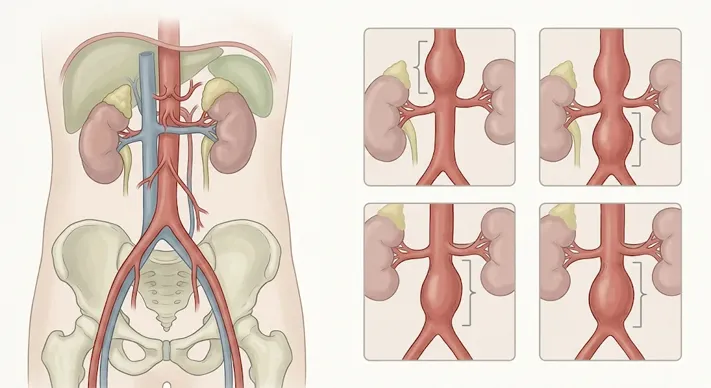
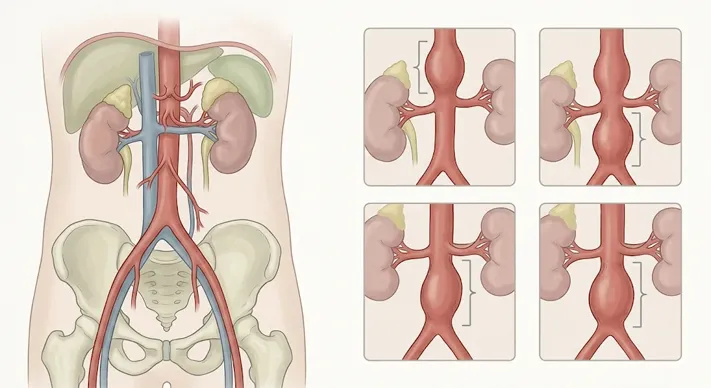
The renal arteries branch off the aorta to supply the kidneys. An infrarenal aneurysm sits below that point, in the stretch of aorta between the kidneys’ blood supply and where the aorta divides into the iliac arteries in the pelvis. It is the pattern clinicians most often describe, which is why I71.43 gets so much attention.
For an unruptured infrarenal aneurysm, the code is I71.43. For a ruptured one, it is I71.33.
The neighbouring terms describe aneurysms that sit closer to, or involve, the renal arteries:
- Juxtarenal generally means the aneurysm begins immediately below the renal arteries, leaving little or no healthy aorta between the two. Repairing one can be more complex because the surgeon has less room to place a clamp or graft.
- Pararenal generally means the aneurysm involves the aorta around the renal artery origins.
These definitions vary somewhat between surgeons and imaging reports, which is another reason coders rely on the provider’s own wording.
It also helps to know what lies beyond this family. Aneurysms that extend from the chest into the abdomen are thoracoabdominal and fall under I71.5- and I71.6-, which include terms like supraceliac and paravisceral. They are not interchangeable with I71.4-.
Ruptured AAA: the I71.3- codes
When an abdominal aortic aneurysm has ruptured, the codes shift to the I71.3- family:
- I71.30: Abdominal aortic aneurysm, ruptured, unspecified
- I71.31: Pararenal abdominal aortic aneurysm, ruptured
- I71.32: Juxtarenal abdominal aortic aneurysm, ruptured
- I71.33: Infrarenal abdominal aortic aneurysm, ruptured
The location logic is identical to the unruptured group, so a ruptured infrarenal aneurysm takes I71.33, while one with no documented location takes I71.30.
Rupture status is a documentation fact, not a risk estimate. An aneurysm that could rupture someday is coded as without rupture until the record states otherwise. It would be wrong to read the unruptured codes as a warning that rupture is likely, because many aneurysms are monitored for years without rupturing. Risk does rise with factors such as size, smoking and uncontrolled blood pressure, and the latter often goes unnoticed, as HealthPage’s article on high blood pressure and heart disease explains.
A ruptured aneurysm is a medical emergency. Sudden, severe abdominal or back pain, especially with dizziness or collapse, needs emergency services immediately, not a code lookup.
AAA screening ICD 10: Z13.6 and Medicare’s billing rules
Screening codes answer a different question from diagnosis codes. When a person has no known aneurysm and is having an ultrasound to check for one, the claim describes a screening encounter, not an aneurysm. Using I71.40 or I71.43 on a screening claim for someone with no diagnosed AAA would misstate the encounter.
For Medicare, the relevant codes are:
| Code | What it represents |
|---|---|
| Z13.6 | Encounter for screening for cardiovascular disorders |
| Z87.891 | Personal history of nicotine dependence |
| F17.21- (F17.210, F17.211, F17.213, F17.218, F17.219) | Current cigarette nicotine dependence, as listed by Medicare contractors |
| Z84.89 | Family history of other specified conditions |
| CPT 76706 | The screening ultrasound procedure itself |
Note that the F17.21- family is not a continuous run from 210 to 219. A Medicare contractor’s list names the five valid codes shown above.
CMS Transmittal 13694, issued March 19, 2026, updated its Claims Processing Manual guidance for AAA screening, with an April 20, 2026 implementation date. Under the updated approach, Z13.6 is reported together with a qualifying code, either a smoking-history or current-dependence code, or a family-history code. A family-history code can also stand on its own. Medicare contractor guidance describes the benefit as once per lifetime, available to men aged 65 to 75 who have smoked at least 100 cigarettes or to people with a family history of AAA, and requiring a referral from the treating provider.
Two clarifications apply. First, these are Medicare-specific rules. Private insurers and Medicare Advantage plans may apply different criteria, so check each payer’s policy. Second, CPT codes describe the procedure, not the diagnosis, a distinction that HealthPage’s explanation of CPT code 93306 illustrates for echocardiography.
According to the ICD-10-CM official guidelines, if screening turns up a condition, the condition can be reported as an additional diagnosis. Follow-up visits for a newly found aneurysm are then coded as diagnosis encounters (I71.4- or I71.3-), not screening visits.
Older I71.4 references: why they can mislead
Before October 1, 2022, I71.4 was a complete code, and I71.3 was the equivalent for ruptured cases. In the FY 2023 update, both became parent categories, each gaining four new five-character codes for unspecified, pararenal, juxtarenal and infrarenal locations, as AAPC described at the time.
You will still see “I71.4” in older articles, outdated superbills, payer policy documents and EHR favorites lists. Treat it as a family name, not a final answer. If a system still accepts I71.4 as a standalone code for dates of service after the change, that is a template problem worth fixing, because claims can be rejected for insufficient specificity.
Frequently asked questions
What is the ICD-10 code for abdominal aortic aneurysm?
There is no single code. Unruptured aneurysms use I71.40 to I71.43, and ruptured ones use I71.30 to I71.33. The fifth character reflects the documented location.
Is I71.40 or I71.43 the right code for AAA without rupture?
I71.43 applies when the record documents an infrarenal location. I71.40 is for cases where the location is not specified. If the record is ambiguous, query the provider rather than defaulting to I71.40.
Can I use Z13.6 if the patient already has a known AAA?
No. Z13.6 is for screening encounters. A known aneurysm is reported with the appropriate I71.3- or I71.4- code, and surveillance imaging has its own procedure coding.
Does the ICD-10 code decide treatment or diagnosis?
No. A code summarises what a clinician has already documented. It neither establishes a diagnosis nor determines treatment.
Do other insurers follow Medicare’s AAA screening code rules?
Not necessarily. Private plans and some Medicare Advantage plans set their own policies, so verify the payer’s coverage criteria before billing.
Where do I find the official code descriptions?
The CMS and CDC publish the annual ICD-10-CM files each October. Use those, along with the official coding guidelines, as the final authority.
Conclusion
The aaa icd 10 question comes down to three checks: is it a screening or a diagnosis, has the aneurysm ruptured, and what location does the record document? Answer those and the code follows, whether that is I71.43 for an unruptured infrarenal aneurysm, I71.33 for a ruptured one, or Z13.6 with a qualifying code for a Medicare screening. Whenever the location is vague, ask the provider before settling for the unspecified code.
For related reading, HealthPage’s cardiology guides cover other heart and vascular topics.
Disclaimer: This article is educational and does not replace professional coding advice or medical evaluation. Code descriptions and payer rules change, so a qualified medical coder or clinician should confirm the final codes for any claim.
References
- CMS, Transmittal 13694, Update to Pub. 100-04, Chapter 18, Section 110.3.2 (AAA Screening), issued March 19, 2026. https://www.cms.gov/files/document/r13694cp.pdf
- AAPC, Cardiology Updates: Find Out About Aortic Aneurysm Coding Changes. https://www.aapc.com/codes/coding-newsletters/my-icd-10-coding-alert/cardiology-updates-find-out-about-aortic-aneurysm-coding-changes-172930-article
- CDC NCHS, Comprehensive Listing of ICD-10-CM Files. https://www.cdc.gov/nchs/icd/comprehensive-listing-of-icd-10-cm-files.htm
- Noridian Medicare (JE Part B), Ultrasound Screening for Abdominal Aortic Aneurysm (AAA). https://med.noridianmedicare.com/web/jeb/topics/preventive-services/ultrasound-screening-for-abdominal-aortic-aneurysm

Dr. Akram Chang is a veteran Cardiac Specialist with extensive clinical experience serving at the historic
Gulab Devi Teaching Hospital in Lahore.
Specializing in clinical cardiology, myocardial preservation, and preventative cardiovascular health, he dedicates his medical career to both critical inpatient care and global public health literacy.
As a core panelist on the HealthPage Medical Review Board,
Dr. Chang provides rigorous clinical oversight, expert fact-checking, and medical verification for our thoracic and circulatory care resources. His analytical oversight ensures that complex hospital diagnostics are translated into safe, actionable, and strictly evidence-based lifestyle habits.
✉ Professional Inquiries:
[email protected]