
Steps to Calories Calculator: Estimate Calories Burned by Walking
Most step counters hand you a number and leave you to guess what it means. A steps to calories calculator fills that gap by turning a day’s walking into an estimated energy figure, using your body weight, your pace and the length of your stride. Think of it as a calories burned walking calculator that shows its working, so you can see the assumptions, change them and decide how much weight the result deserves.
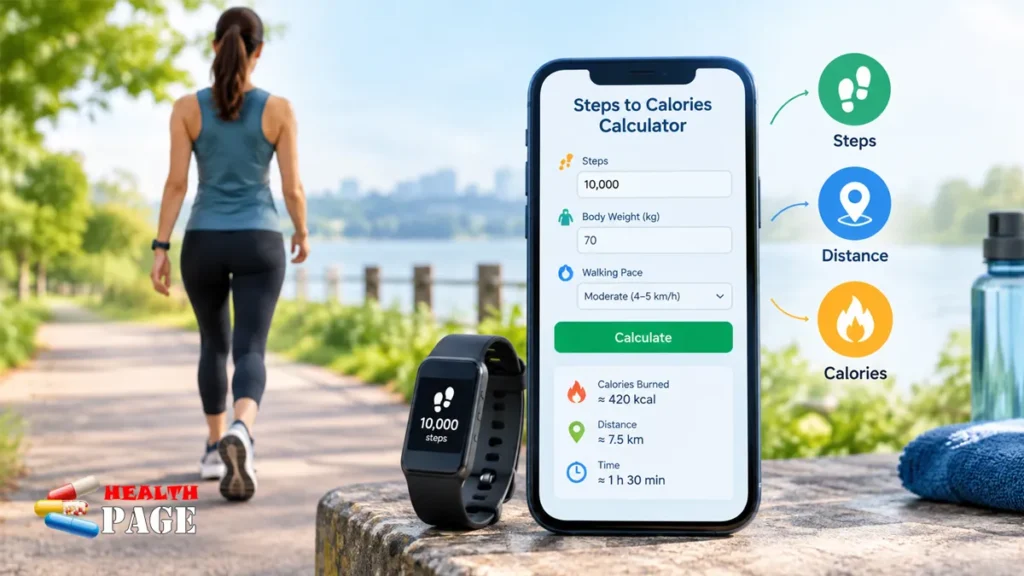
The short answer: a person weighing about 70 kg (154 lb) who walks at a moderate pace burns roughly 40 calories per 1,000 steps. That puts 10,000 steps near 420 gross calories. Lighter people burn less, heavier people burn more, and nobody’s figure is exact. The rest of this guide explains where these numbers come from and how to use them sensibly.
Estimate Your Own Number in 30 Seconds
You do not need software to get a personal estimate. This method mirrors what most walking calorie calculator pages do behind the scenes. It assumes a moderate pace of 5 km/h (about 3.1 mph) and an average step length of 0.75 metres (about 2.5 feet).
Metric: calories ≈ steps × body weight (kg) × 0.0006
Imperial: calories ≈ steps × body weight (lb) × 0.00027
For example, 8,000 steps at 82 kg gives 8,000 × 82 × 0.0006 ≈ 394, which rounds to about 395 calories. This is a gross figure, meaning it includes the energy your body would have used at rest anyway. To get the net figure (the extra energy walking added), multiply by 0.74. The section on gross versus net calories explains why that matters.

How Many Calories Can Walking Burn?
Walking energy use depends mainly on two things: how much body mass you move and how long you spend moving it. At the moderate pace above, a 70 kg adult uses about 280 calories per hour. At a brisk 6 km/h, that rises to roughly 350 per hour. Both figures come from the MET method described below.
Steps are a convenient way to track that effort because they are easy to count. They are only a proxy, though. Ten thousand short, slow steps around the house and ten thousand long strides on a hill are very different workloads, which is why a good calculator asks for more than a step count.
What you eat matters as much as what you burn, so it helps to read these figures alongside practical healthy food guides rather than treating walking calories in isolation.
How the Calculation Works
A MET calorie calculation rests on the metabolic equivalent of task. One MET is the energy cost of sitting quietly, and every activity is expressed as a multiple of that. The 2024 Adult Compendium of Physical Activities, published in the Journal of Sport and Health Science, assigns each activity a MET value based largely on laboratory measurements of oxygen use. The commonly used conversion is:
Calories = MET × 3.5 × body weight (kg) ÷ 200 × minutes
The 2024 Adult Compendium walking values used here are:
- 3.0 METs for walking at 2.5 mph (4 km/h) on a firm, level surface
- 3.8 METs for 2.8 to 3.4 mph (4.5 to 5.5 km/h)
- 4.8 METs for 3.5 to 3.9 mph (5.6 to 6.3 km/h)
- 5.5 METs for 4.0 to 4.4 mph (6.4 to 7.1 km/h)
One caveat: this edition was tailored for adults aged 19 to 59, and a separate Older Adult Compendium exists for people 60 and over.
Because the formula needs minutes rather than steps, a steps-to-calories calculator chains several estimates together:
- Steps to distance. Step count multiplied by step length.
- Distance to time. Distance divided by walking speed.
- Time to calories. The MET formula above.
Step length is the shakiest link. Many calculators estimate it from height, often around 0.41 to 0.42 times height as a rule of thumb. But height alone does not determine stride. Leg length, fitness, speed and footwear all play a part, so this guide uses one fixed 0.75 m step so every figure rests on the same documented assumptions. All results are rounded to the nearest 5 calories to avoid false precision.
Calories Burned per 1,000 Steps
Here are the calories burned per 1,000 steps and for larger counts, using the assumptions above. Each 1,000 steps covers about 0.75 km (0.47 mile) and takes about 9 minutes.
| Steps | 55 kg (121 lb) | 70 kg (154 lb) | 85 kg (187 lb) | 100 kg (220 lb) |
|---|---|---|---|---|
| 1,000 | 35 | 40 | 50 | 60 |
| 5,000 | 165 | 210 | 255 | 300 |
| 8,000 | 265 | 335 | 405 | 480 |
| 10,000 | 330 | 420 | 510 | 600 |
| 15,000 | 495 | 630 | 765 | 900 |
Gross calories, rounded to the nearest 5. Assumes 5 km/h (3.8 METs), a 0.75 m step and level, firm ground. Because of rounding, rows do not scale perfectly.
The same table doubles as a rough steps to miles calculator. 5,000 steps is about 2.3 miles (3.75 km), 8,000 is about 3.7 miles (6 km), 10,000 is about 4.7 miles (7.5 km) and 15,000 is about 7 miles (11.25 km). At typical stride lengths, a mile usually takes somewhere between 2,000 and 2,200 steps.
How Many Calories Do 10,000 Steps Burn?
For a 70 kg adult at a moderate pace, 10,000 steps burn about 420 gross calories, or about 310 net. The walk covers around 7.5 km and takes roughly 90 minutes. Published estimates for 10,000 steps commonly range from about 300 to about 500, and the spread mostly reflects different assumptions about weight, stride and pace rather than any disagreement about the science.
Pace changes the picture in a way that surprises people. Using the same 70 kg adult and the same fixed step length:
| Pace | Time for 10,000 steps | MET used | Gross calories |
|---|---|---|---|
| Easy, 4 km/h (2.5 mph) | about 1 h 53 min | 3.0 | 415 |
| Moderate, 5 km/h (3.1 mph) | 1 h 30 min | 3.8 | 420 |
| Brisk, 6 km/h (3.7 mph) | 1 h 15 min | 4.8 | 440 |
When the distance is fixed, walking faster raises the total only slightly in this simplified model. What changes is how many calories you burn per minute and how hard the walk feels. In real life people also lengthen their stride as they speed up, so the same step count covers more ground and costs more energy.
Ten thousand steps is a popular target, not a medical threshold. It is also not the same workload for everyone, because it can mean 6 km for one person and 8 km for another.
Why Weight, Height, Pace and Terrain Change the Result
Body weight. The pattern behind steps to calories by weight is simple: moving more mass costs more energy. In the table, the same 10,000 steps come to about 330 calories at 55 kg and about 600 at 100 kg. That does not mean a heavier person is “better” at burning calories. It means the same walk is a bigger physical task for them, which is also why joint comfort matters more as body weight rises.
Height and stride. A taller person usually takes fewer steps per kilometre. Two people can log the same 10,000 steps while one has walked noticeably farther. A step-based calculator that ignores height treats them as equal, and one that estimates stride from height may still be wrong for individuals with unusual proportions.
Terrain and incline. Hills, sand, grass and uneven trails ask more of your muscles than a flat pavement or a treadmill. The Compendium reflects this: a grass track is listed at 4.8 METs, against 3.8 for a moderate pace on firm, level ground. A calculator that assumes flat ground will usually understate a hilly walk.
Fitness and walking mechanics. Two people of the same weight can use slightly different amounts of energy at the same speed. Calculators cannot see that, which is one reason any single figure should be read as a range.

Gross vs Net Calories, and How Accurate Are the Estimates?
Gross calories are the total energy your body uses while you walk. That includes the energy it would have burned at rest during the same period. Net calories subtract that resting portion, leaving only the extra cost of walking. For our 70 kg walker covering 10,000 steps, the gross figure is about 420 and the net figure about 310. The calculator on this page reports gross. Different calculators and devices use different conventions, and not all of them say which one they show, so two tools can disagree without either being “wrong.”
Every estimate here is built from averages. The Compendium’s MET values come from measuring groups of people, usually by indirect calorimetry, and then applying them to individuals. Direct measurement of one person’s energy use requires laboratory equipment that measures oxygen consumption. A pedometer or smartwatch cannot do that. It counts motion, combines it with the profile you entered, and estimates. If you are curious how consumer wearables hold up when measuring something else, HealthPage explains how accurate smartwatch heart-rhythm readings are and where they stop being a substitute for clinical testing.
A sensible way to hold the number loosely: treat 420 calories as “somewhere between roughly 350 and 500.” Use the estimate to compare one week with another, not to settle an argument about a single day.
Calorie estimates also cannot predict weight change on their own. Appetite, food intake, sleep, metabolism and body composition all shift in response to activity, so the same walk can lead to different outcomes in different people.
Using Step Counts in a Healthy Routine
The most useful role for a steps-to-calories calculator is as a motivator and a measuring stick, not a verdict. The CDC’s adult physical activity guidelines recommend at least 150 minutes of moderate-intensity activity a week, with brisk walking as a standard example, plus muscle-strengthening activity on two days. They also note that some activity is better than none.
Step targets have their own evidence base. A 2025 systematic review and dose-response meta-analysis in The Lancet Public Health (Ding and colleagues) pooled prospective studies of device-measured steps. Compared with 2,000 steps a day, about 7,000 steps was associated with a 47% lower risk of all-cause mortality, and the benefit curve flattened around 5,000 to 7,000 steps for several outcomes. The authors rated the certainty of evidence as moderate for most outcomes and flagged limitations, including few studies for some outcomes and residual confounding. These are associations, not guarantees, and they do not show that fewer steps offer no benefit. For readers interested in how everyday activity connects with the cardiovascular system, HealthPage’s heart health articles are a useful companion.
A few practical habits make step goals easier to keep:
- Raise your daily average gradually instead of jumping from 3,000 to 10,000 steps.
- Count brisk walks toward your weekly minutes, since pace matters for intensity.
- Use the calculator to compare weeks, keeping the same settings each time.
A sudden jump in walking can irritate the knees, and inner-knee pain after longer walks is common enough to have its own rehabilitation guidance. HealthPage covers exercises for inner-knee pain from pes anserine bursitis, which may help if that sounds familiar.
Calves can also protest when your step count rises quickly. If that happens, Healthy Post explains common reasons for muscle cramps and when a cramp is worth mentioning to a clinician.
Anyone with a heart condition, joint disease, pregnancy-related concerns or new symptoms such as chest pain, dizziness or unusual breathlessness should check with a qualified professional before raising activity levels.

Frequently Asked Questions
How many steps does it take to burn 100 calories?
For a 70 kg adult at a moderate pace, about 2,400 steps burns roughly 100 gross calories. At 55 kg it takes about 3,000 steps, and at 85 kg about 2,000. Net calories take more steps, since resting energy is subtracted.
Is my smartwatch’s calorie number more reliable than a calculator’s?
Not necessarily. A watch can use heart rate and movement, which may capture your effort better on a given day, but it is still estimating. Whichever you use, consistency matters more than absolute accuracy: compare like with like over time.
Should I eat back the calories I burn walking?
There is no universal rule. Because the estimates are uncertain and may be gross rather than net, eating back every calorie can easily overshoot. Appetite is a reasonable guide for most healthy adults. If you are following a specific nutrition or weight plan, a registered dietitian can tailor the advice.
Do I really need 10,000 steps a day?
No. Ten thousand is a convenient round number rather than a clinical requirement. The CDC guidance is framed in minutes of moderate activity, and the 2025 review found meaningful associations at around 7,000 steps for several outcomes. More active people may still reasonably aim higher.
Why do online calculators give different answers?
They differ in step length, pace, MET values and whether they report gross or net calories. A tool that states its assumptions is easier to judge than one that gives only a number.
Conclusion
A steps to calories calculator is best understood as a transparent estimate: steps become distance, distance becomes time, and time at a given pace becomes energy. For a 70 kg adult at a moderate pace, that works out to about 40 calories per 1,000 steps and about 420 gross calories for 10,000. Your own result will shift with weight, stride, terrain and pace.
The most useful next step is to run your own numbers with the quick formula, note whether you are looking at gross or net figures, and use the result to track your routine over several weeks rather than judging any single day.
Sources
- Herrmann SD, Willis EA, Ainsworth BE, et al. “2024 Adult Compendium of Physical Activities: A third update of the energy costs of human activities.” Journal of Sport and Health Science, 2024. Walking MET values: Compendium of Physical Activities, “Walking” (pacompendium.com/walking/).
- Ding D, Nguyen B, Nau T, et al. “Daily steps and health outcomes in adults: a systematic review and dose-response meta-analysis.” The Lancet Public Health, 2025;10(8):e668-e681 (PubMed 40713949).
- Centers for Disease Control and Prevention. “Adult Activity: An Overview,” Physical Activity Basics.

Dr. John Ma is a dedicated Orthopaedic Surgeon with extensive experience in musculoskeletal health and surgical care. He currently serves at Royal Brisbane and Women’s Hospital, Australia, where he provides expert treatment for complex orthopaedic conditions. Passionate about advancing patient outcomes, Dr. Ma combines evidence‑based practice with compassionate care, helping individuals restore mobility and improve quality of life. Through his contributions to healthcare, he continues to support patients in achieving long‑term wellness and recovery.