
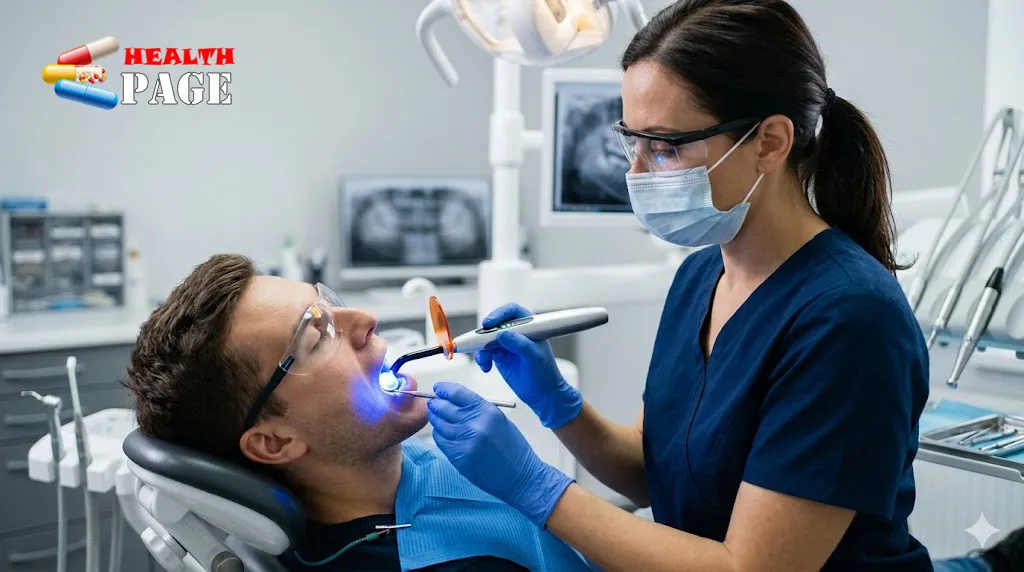
Why Do Dentists Use a Dental Curing Light for Fillings? (Is It Safe?)

Dr. Suleman Khan is a registered Dental Surgeon dedicated to modern preventative oral health, maxillofacial insights, and advanced clinical treatment approaches. Based at the prestigious
Government Dental College and Hospital in Ahmedabad and registered under the Dental Council of India, he brings extensive hands-on experience in public health dentistry and preventative medicine.
As a core specialist panelist on the HealthPage Medical Review Board,
Dr. Khan provides expert clinical oversight, rigorous fact-checking, and medical verification for our oral health and dental surgery articles. He focuses on simplifying dense orthodontic and hygienic concepts into accessible, safe, and actionable guidance that reflects current healthcare standards.
✉ Professional Inquiries:
[email protected]
⚖️ Oral Health Review & Disclaimer
This clinical article was authored by Dr. Suleman Khan (Dental Surgery). The technical discussion surrounding composite resin polymerization, blue LED light safety, and post-operative pulpal sensitivity is intended strictly for educational, informational, and patient-guidance purposes. It does not constitute formal dental diagnosis, a professional chairside assessment, or an official oral surgery treatment plan.
While modern light-curing techniques are exceptionally safe, persistent throbbing, severe tooth sensitivity after light curing, or an uneven bite following a composite restoration requires an immediate physical evaluation. Always consult your primary dentist or oral health specialist regarding specific clinical symptoms, dental anxieties, or individual procedure protocols. Never delay or disregard professional dental care or emergency treatment because of data or summaries read on this website.
If you have ever watched your dentist place a white filling, you probably noticed a bright blue glow aimed at your tooth. That device is called a Dental Curing Light, and it plays a central role in modern restorative dentistry. In our clinical editorial work, we often find that patients are less worried about the filling itself than about the unfamiliar equipment used during the procedure. That concern is reasonable. People want to know what the light does, why it is needed, and whether it is safe for their teeth, gums, and eyes.
The short answer: dentists use a curing light to harden tooth-colored materials quickly and predictably. When used correctly, it is considered safe. But the full story is more interesting. The science involves chemistry, light wavelengths, heat control, eye protection, and technique. It also helps explain why some people notice tooth sensitivity after light curing, while others do not.
This article breaks it down in plain language. We will cover how the light works, why modern clinics use LED systems instead of older technologies, what blue LED dental light safety really means, and what patients should expect during and after treatment. If you are also researching other oral health concerns, topics like Effective Ways to Treat a Bump on Gums Safely, What is ceramic braces, its Pros and cons, and Missing Tooth Clause Impacts often come up alongside restorative dental care.
1. What Is a Dental Curing Light?
A Dental Curing Light is a handheld dental device that emits a focused beam of visible blue light. Dentists use it to harden certain materials placed inside or on a tooth, including:
- Tooth-colored fillings
- Dental sealants
- Bonding agents
- Some cements used with crowns or orthodontic attachments
Think of it as a controlled “on switch” for dental material. Before the light is applied, the filling material is soft enough for the dentist to shape. After exposure, it becomes firm and functional within seconds.
Modern curing units are usually LED-based. They are compact, efficient, and designed to deliver a very specific light range. That matters because the filling material does not harden from just any light. It needs the right wavelength, delivered at the right distance and angle, for the chemistry to work properly.
2. How Does It Harden a Filling? The Science Made Simple
The hardening process is called composite resin polymerization. That term sounds technical, but the idea is straightforward.
Most white fillings are made from composite resin. This material contains:
- A resin matrix made of small molecules called monomers
- Tiny filler particles that improve strength
- A light-sensitive chemical called a photoinitiator
The most common photoinitiator is camphorquinone. It responds to blue light, typically in the range of about 455 to 481 nanometers. These blue LED dental light wavelengths activate the photoinitiator, which then creates reactive molecules called free radicals. Those free radicals link the monomers together into a hard, cross-linked structure.
In simple terms: the blue light turns a moldable paste into a durable filling.
Most studies agree that this reaction can happen quickly, often within 20 to 60 seconds per layer, but speed depends on:
- The type of composite
- The thickness of the layer
- The power of the curing unit
- The distance of the light tip from the filling
- The angle of the beam
A small tilt or a few extra millimeters of distance can reduce the energy reaching the material. That may leave the bottom of the filling under-cured. Under-cured resin may wear faster, stain more easily, or fail earlier.
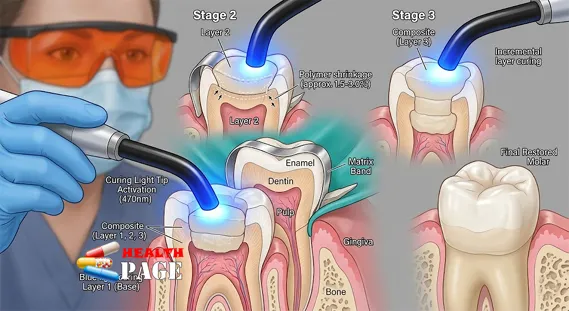
Why dentists place fillings in layers
Dentists usually place composite in small increments rather than one thick block. This helps with:
- More complete composite resin polymerization
- Better depth of cure
- Lower shrinkage stress
- Improved dental pulpal heat protection
That layering technique is one of the quiet details patients rarely notice, but it can strongly affect how long a filling lasts.
3. Why Not Let the Filling Harden on Its Own?
Some dental materials do self-cure, meaning they set through a chemical reaction without light. But light-cured composite offers major practical advantages.
Reasons dentists prefer light-cured composite
- More working time
The dentist can shape the material carefully before activating it. - Better esthetics
Tooth-colored composites can be polished and blended more precisely. - Faster treatment
Once cured, the restoration is ready much sooner. - Immediate function
Patients can usually bite and chew normally shortly after the visit, depending on the procedure. - Stronger control over the result
Light activation gives the clinician more control over timing and layering.
This control is especially useful in visible areas, such as front teeth, where shape, texture, and color matter. It also supports conservative dentistry, where less healthy tooth structure may need to be removed.
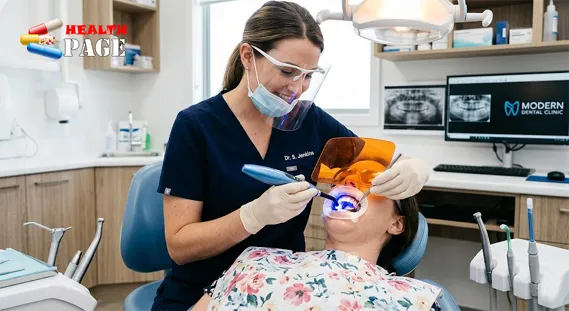
4. UV Dental Light vs LED: Why Dentistry Moved On
The question of uv dental light vs led comes up often, especially online where older information still circulates.
Early light-curing systems from the 1970s used ultraviolet light. Over time, dentistry moved away from that approach for good reasons. UV systems had several drawbacks:
- Less effective depth of cure
- Greater risk to oral tissues and eyes
- Color instability in some materials
- Less efficient energy delivery
Later came Quartz-Tungsten-Halogen, or QTH, units. These improved curing but generated more heat and were less energy-efficient. Today, LED systems dominate because they emit a narrower, more targeted spectrum matched to modern dental materials.
UV dental light vs LED in plain terms
| Feature | Older UV Systems | Modern LED Systems |
|---|---|---|
| Wavelength target | Broad/less ideal | Precise for dental photoinitiators |
| Safety profile | More concerning | Safer when used properly |
| Heat generation | Higher concern | Lower ambient heat |
| Energy efficiency | Lower | Higher |
| Material compatibility | More limited | Broad, especially with polywave models |
So in the uv dental light vs led comparison, LED technology is the clear modern standard.
What about newer composites?
Some newer materials use alternative photoinitiators such as Ivocerin or Lucirin TPO. These may respond to shorter wavelengths closer to violet light. That is why some clinics use polywave curing lights, which emit both blue and violet ranges rather than a single narrow band.
This is an important update for patients. Not all lights are identical, and not all composites behave the same way.
5. Is a Dental Curing Light Safe?
For the average patient, a Dental Curing Light is considered safe when used properly by trained dental professionals. It is not a laser, and it does not burn tissue under normal use. But “safe” does not mean “risk-free in every context.” The main safety issue is eye exposure.
Blue LED dental light safety explained
The concern around blue LED dental light safety focuses on the eye’s sensitivity to blue wavelengths, especially roughly within 380 to 550 nanometers. The curing light’s output overlaps with that range. Looking directly at the beam, or even at strong reflections from a shiny tooth surface, may increase retinal exposure over time.
This matters more for dental staff because their exposure is repeated throughout the day. Research discussed in the dental literature, including work indexed on PubMed, has raised concerns about cumulative blue-light exposure for clinicians and assistants.
How dental teams reduce the risk
Dental practices use several safeguards:
- orange eye protection shields
- Blue-light-blocking glasses
- Tip-mounted filters
- Careful angling of the light
- Avoiding direct line-of-sight exposure
Cheap shields sold online are not always reliable. Laboratory testing has shown that some unverified products may allow hazardous wavelengths to pass through. That is why reputable clinics typically rely on manufacturer-approved barriers and equipment that meets regulatory standards.
In the United States, dental curing lights are generally regulated through FDA clearance pathways. You can review broader device oversight principles through the FDA.
What patients usually notice
Most patients only see a brief blue glow for a few seconds at a time. Dentists often ask you to look away or provide protective glasses. That is standard practice, not a sign that the light is dangerous in ordinary use.
6. Can It Cause Tooth Sensitivity Afterward?
Yes, tooth sensitivity after light curing can happen, but the light itself is only part of the story.
There are two main reasons:
A. Heat generation
The curing process creates localized thermal energy. If too much heat reaches the tooth’s pulp, it may irritate the inner tissue. Dentists reduce this risk with layering, proper timing, and modern devices designed with better dental pulpal heat protection.
B. Polymerization shrinkage
As the composite hardens, it contracts slightly. This shrinkage can create stress at the edges of the filling or on the tooth structure. If that stress is significant, the patient may feel short-term sensitivity, especially to cold or biting pressure.
Signs that are common after a filling
- Mild cold sensitivity for a few days
- Slight soreness when biting
- Temporary awareness of the tooth
When to call the dentist
- Pain worsens instead of improving
- Biting feels uneven
- Sensitivity lasts more than a couple of weeks
- There is throbbing, swelling, or spontaneous pain
In clinical review, we often see that a “sensitive filling” is not due to one single cause. Bite adjustment, cavity depth, bonding stress, and pre-existing tooth inflammation may all play a role.
7. Why Technique Matters More Than Patients Realize
A Dental Curing Light is only as effective as the way it is used.
That may sound surprising. Many people imagine the material hardens no matter what. In reality, technique matters a great deal.
Small details that affect curing quality
- The curing tip should be close to the filling
- The light should be aimed straight, not tilted
- Exposure time should match the material
- The resin should be placed in proper thickness increments
- The tip should be clean, not coated with residue
If the tip is held too far away, the radiant exposure drops. That means less energy reaches the composite. The top may look set, but the lower part may not be fully cured. This is one reason experienced clinicians pay close attention to positioning.
It is similar to drying paint with a heat tool. If the tool is too far away or moved too quickly, the surface may appear dry before the deeper layer is ready.
8. Practical Questions Patients Often Ask
Does the blue light contain UV?
Modern systems are usually visible blue LED devices, not traditional ultraviolet units. The uv dental light vs led distinction matters because modern LEDs are designed for safer, more precise curing.
Can the light damage my gums?
Used properly, it is not expected to damage gums or cheeks. The beam is targeted and brief.
Why did my dentist cure the filling several times?
Because fillings are often placed in layers. Each layer needs adequate curing for better strength and a lower risk of tooth sensitivity after light curing.
Why was I told not to stare at it?
That advice relates to blue LED dental light safety. Dental teams use orange eye protection shields and ask patients to look away to reduce unnecessary eye exposure.
Is this related to other dental procedures?
Yes. Similar light-cured materials are also used in sealants, orthodontics, and some cosmetic procedures. If you are exploring broader care options, articles like What is ceramic braces, its Pros and cons and Missing Tooth Clause Impacts may help connect the bigger picture.
FAQs
1. How long does a Dental Curing Light take to harden a filling?
Usually 20 to 60 seconds per layer, depending on the material, thickness, and light intensity.
2. Is a Dental Curing Light safe for children?
In routine dental care, it is generally considered safe when used properly. Pediatric dentists still use eye protection and careful technique.
3. Why do I have tooth sensitivity after light curing?
Tooth sensitivity after light curing may be linked to heat, shrinkage stress, bite changes, or the depth of the cavity rather than the light alone.
4. Are LED curing lights better than UV lights?
Yes. In the uv dental light vs led comparison, modern LEDs are more precise, efficient, and safer for current materials.
5. What protects the dentist’s eyes?
Clinicians use orange eye protection shields, filtering glasses, and positioning strategies to support blue LED dental light safety.
6. Can a poorly cured filling fail early?
Yes. Incomplete composite resin polymerization may increase the chance of wear, leakage, staining, or fracture.
Conclusion
A Dental Curing Light is one of the key tools that makes modern white fillings practical, durable, and convenient. It allows dentists to shape composite carefully, then harden it within seconds through composite resin polymerization. That is why many patients can leave the office and return to normal chewing soon after treatment.
As for safety, the evidence supports proper use. The biggest concern is not the tooth. It is eye exposure, which is why blue LED dental light safety protocols matter so much in clinical practice. Protective filters, orange eye protection shields, correct technique, and modern LED technology all help reduce risk.
If you experience tooth sensitivity after light curing, it is often temporary. But persistent pain deserves a dental review. A good dentist will check the bite, the depth of the filling, and whether the restoration cured as intended.
If you are comparing treatment options or dealing with related issues, you may also want to explore Effective Ways to Treat a Bump on Gums Safely, What is ceramic braces, its Pros and cons, and Missing Tooth Clause Impacts as part of a broader oral health plan.
