

When Does the Umbilical Cord Fall Off? 5 Important Facts for New Parents
Medical Disclaimer: The information provided in the article “When Does the Umbilical Cord Fall Off? 5 Important Facts for New Parents”, written by Dr. Wang Zhixin (Gynecology), is for educational and informational purposes only and is not intended as a substitute for professional medical advice, diagnosis, or treatment.
Every newborn heals at their own pace. Always seek the advice of your pediatrician, midwife, or other qualified healthcare provider with any questions you may have regarding umbilical cord care or your baby’s health. Never disregard professional medical advice or delay seeking it because of something you have read in this article. If you notice redness, swelling, foul-smelling discharge, bleeding, or a fever, seek immediate medical attention.
Most parents spend the first few days at home wondering about the small, dark stump on their baby’s belly. When does the umbilical cord fall off? Usually within one to three weeks of birth, and the exact day varies from one baby to the next. The stump dries, shrinks and drops away without any help, so the main jobs are keeping it clean, keeping it dry and resisting the urge to pull.
This guide covers what happens before the stump separates, how to look after it, which small changes are ordinary, and which symptoms should prompt a call to a doctor or midwife.
When Does the Umbilical Cord Fall Off After Birth?
At birth the cord is clamped and cut, leaving a short stump attached to the navel. Medical references give slightly different windows. MedlinePlus describes separation at roughly 5 to 15 days, and other clinical sources allow up to three weeks. The American Academy of Pediatrics says the stump should dry and fall off by the time a baby is 3 weeks old.
So if someone tells you it must be gone in the first week, that is a common average, not a rule. A stump still attached at day 14 is not a cause for concern on its own.
Several things can shift the timing, though research hasn’t pinned down exactly how much each matters. A thicker cord holds more moisture and takes longer to dry. A stump that stays damp from urine, or is kept covered, tends to dry more slowly. Babies born earlier may follow a different pace, so premature babies are best discussed with their care team.
If you search for when does the umbilical cord fall off newborn, the answer is the same: a range, not a date. The question parents often really mean is how long does the umbilical cord stump take to fall off before it becomes a concern. The usual answer is up to three weeks, with a medical check if it hasn’t separated by then.
A rough timeline
| Stage | What you may see |
|---|---|
| First few days | Yellowish-white, glossy, slightly damp stump, possibly with a clamp |
| Days 3 to 7 | Drying and darkening to brown, grey or black |
| Weeks 1 to 2 | Hard, shrivelled, may hang by a thread; most stumps separate in this window |
| Weeks 2 to 3 | Still normal if it remains attached and looks dry |
| After 3 weeks | Mention it to your baby’s doctor; around 4 weeks it needs evaluation |
Whether the clamp comes off earlier or with the stump depends on local hospital practice, so follow what your midwife told you.

What Happens Before the Umbilical Cord Falls Off?
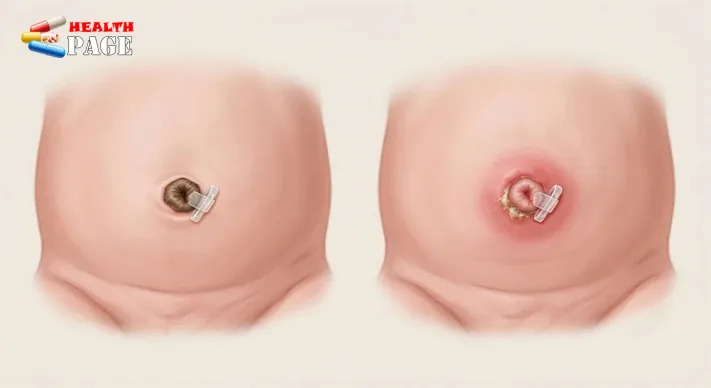
The cord has no nerves in it, which is why a baby does not feel the stump separating. Once the blood supply is cut off, the tissue dries out, shrinks and changes colour, much like a scab. Right after birth it looks pale, glossy and slightly moist. As it dries it can turn brown, grey or black. Many parents find the colour alarming, but a darkened, hardened stump is the expected pattern.
You might also notice a slight smell as the tissue dries, or a tiny amount of sticky, clear-to-yellowish moisture at the base. The distinction that matters is between a small amount of drying residue and a strongly foul-smelling, pus-like discharge. The latter is covered further down.
When the stump is nearly detached, it can look alarming, dangling by a thread. Do not pull, twist or cut it, even when it seems ready to come off. Underneath the dry outer tissue there is still living tissue that is healing, and tugging can cause bleeding, pain or a gateway for infection. It will separate when the tissue beneath is ready.
How to Care for a Newborn’s Umbilical Cord Stump
Good newborn umbilical cord care is mostly about doing less. The approach recommended by the AAP and most health services is called dry cord care. That means keeping the area clean and letting air reach it, rather than treating it with products.
Here is what that looks like day to day:
- Wash your hands before touching the area, including during diaper changes.
- Fold the front of the diaper down below the stump, or use newborn diapers with a cut-out, so urine doesn’t soak it.
- Dress your baby in loose clothing so air can circulate.
- If the stump gets dirty, wipe it gently with a cloth dampened with plain water, then pat it dry.
- Give sponge baths until it falls off, rather than submerging your baby in a tub.
The AAP states there is no need to use alcohol on the stump. That is a change from older advice, so you may still hear relatives or older leaflets recommend rubbing alcohol. Powders, creams, oils and home remedies are also best avoided unless your baby’s doctor or midwife has specifically prescribed something. If your hospital gave you different instructions, for instance because of local infection risks, follow those.
A practical point about diapers: newborns pass urine very often, and the stump is right in the splash zone. Checking the diaper position at every change catches most problems before they start. If the stump gets a little wet, dab it dry rather than rubbing.

Is Bleeding or Discharge Normal After the Cord Falls Off?
A little, yes. A few drops of blood on the diaper around the time the stump separates are normal, according to the AAP. You may also see a small raw patch at the base, or a few spots of blood-tinged moisture in the following days. This is the belly button healing, like a graze closing.
The picture changes if the bleeding doesn’t stop, if fresh blood keeps appearing, or if the stump is actively bleeding. The AAP advises calling your baby’s doctor immediately in that case. Discharge that is thick, yellow or foul-smelling also falls outside what is expected and should be checked.
In practical terms:
- Usually fine: a few drops of blood, slight dampness, a darkened and dry stump
- Worth a call: persistent or recurring bleeding, a smell that is clearly unpleasant, sticky yellow discharge
- Urgent: the symptoms in the next section combined with fever or a baby who seems unwell
Signs of Umbilical Cord Infection in Newborns
Infection of the stump is called omphalitis. It is uncommon, but because newborns can become unwell quickly, it is taken seriously. The AAP lists foul-smelling yellowish discharge, red skin around the base of the cord, and crying when the cord or the skin next to it is touched.
Other signs of newborn belly button infection that clinicians watch for include:
- Redness that spreads outward across the belly
- Swelling or a belly button area that feels warm or hard
- Pus around the base
Some symptoms mean your baby may be sick beyond the local skin. A temperature of 38°C (100.4°F) or higher, poor feeding, unusual sleepiness, or a limp, floppy appearance in a newborn calls for immediate medical assessment, not a wait-and-see approach. Use your local urgent number or go to an emergency department if you cannot reach a doctor quickly.
Do not treat suspected infection at home with creams or home remedies. Early assessment and, if needed, antibiotics are what protect the baby.
What Happens After the Umbilical Cord Falls Off?
When the stump falls away, the belly button may look a little raw for a few days. You may see a small scab, a moist area or some pinkish tissue. This usually dries on its own as the skin closes. Keep the area clean and dry, and carry on with diaper folding for a few more days until it looks fully healed.
Some babies develop an umbilical granuloma. This is a small reddish or brownish lump of scar-like tissue that stays in the belly button after the cord has gone and weeps a light yellow fluid. The AAP notes it usually goes away in about a week; if not, a pediatrician can dry it or treat it. It isn’t painful and is not an infection, but it is worth mentioning at a check-up or sooner if the moisture continues.
A different issue is an umbilical hernia: a soft bulge near the navel that pushes out when the baby cries. The AAP describes this as not a serious condition that usually heals by itself in the first 12 to 18 months. Don’t tape a coin or anything else over it, as that can cause a rash without helping.
Many new parents are also recovering from the birth itself. If you had stitches, our guide on perineal tear stitches after childbirth covers healing time and warning signs, which can be easy to overlook while the focus is on the baby.
When Should You Contact a Doctor?
Call your baby’s healthcare professional if you notice:
- A stump that has not fallen off by 3 weeks (the AAP recommends a visit beyond this point)
- Active or repeated bleeding
- Foul-smelling or pus-like discharge
- Spreading redness, swelling or tenderness around the base
- A moist, pink lump that persists after the stump has separated
Seek immediate medical assessment for fever of 38°C (100.4°F) or higher, poor feeding, unusual sleepiness or a floppy baby.
A delayed stump is not the same thing as an infected one. Plenty of babies take a little longer with no problem at all, and a stump that is simply late but dry and clean is usually just that. MedlinePlus advises contacting the provider if it has not separated by 4 weeks, since rarely there can be an underlying reason that a doctor will want to rule out. A visit is about checking, not assuming something is wrong.
Frequently Asked Questions
Can I give my newborn a bath before the cord falls off?
Sponge baths are the usual advice until the stump has gone, because they make it easier to keep the area dry. If the stump does get wet, pat it dry afterwards.
Is it normal for the umbilical cord stump to smell?
A mild, slightly musty odour can occur as the tissue dries. A strong, foul smell, especially with yellow discharge or redness, should be checked.
What if the stump falls off in the first few days?
A very early separation can happen. Watch for bleeding, and ask your midwife or doctor to look at the area if you are unsure.
Does the stump hurt my baby?
No. The cord contains no nerves, so the stump itself is painless. Crying when the skin around it is touched is the thing to note, as it can signal infection.
Will my baby have an innie or an outie?
It isn’t determined by how you care for the stump. Most belly buttons settle into their final shape without intervention, and a bulge that pops out with crying may be a hernia, which usually resolves on its own.
Should I put anything on the stump to speed things up?
No. Dry cord care, meaning keeping it clean and uncovered, is the standard approach. Products, alcohol and home remedies are best left alone unless a clinician prescribes them.
Conclusion
The answer to when does the umbilical cord fall off is a range rather than a single day: typically one to three weeks, with plenty of normal variation. In the meantime, the routine is simple. Keep the stump clean and dry, fold the diaper below it, let it separate without help, and watch for bleeding that doesn’t stop, foul-smelling discharge, spreading redness or any sign that your baby is unwell. If it hasn’t come off after three weeks, a quick check with your doctor settles the question.
Once the belly button has healed, the next few months bring plenty of milestones to watch for, and our overview of what age infants sit up is a useful next read.
This article is for general information and does not replace advice from your baby’s doctor or midwife. It should receive medical review before publication.
References
- MedlinePlus (U.S. National Library of Medicine). “Umbilical cord care in newborns.” https://medlineplus.gov/ency/article/001926.htm
- American Academy of Pediatrics, HealthyChildren.org. “Umbilical Cord Care in Newborns.” https://www.healthychildren.org/English/ages-stages/baby/bathing-skin-care/Pages/Umbilical-Cord-Care.aspx

Dr. Wang Zhixin is a distinguished Chief Physician specializing in comprehensive gynecology, perinatology, and maternal healthcare systems. She serves at the acclaimed
Shenzhen Maternity and Child Healthcare Hospital, a premier Grade-III Class-A medical center associated with Southern Medical University. With decades of clinical leadership, Dr. Wang is widely recognized for her contributions to reproductive wellness, prenatal diagnostic precision, and advanced clinical research safeguarding maternal-fetal medical outcomes.
As a core specialist panelist on the HealthPage Medical Review Board,
Dr. Wang leverages her senior clinical oversight to meticulously fact-check, audit, and medically verify our reproductive medicine and maternal wellness guides. Her analytical reviews ensure that intricate obstetric protocols and feminine wellness data are rendered into safe, authoritative, and completely evidence-based reference resources for global audiences.
✉ Professional Inquiries:
[email protected]