
Foot Reflexology Chart: 7 Key Pressure Points and Their Uses
Medical Disclaimer: The content in “Foot Reflexology Chart: 7 Key Pressure Points and Their Uses” has been written by Dr. Sana Lodhi (General Medicine) and is intended for informational and educational purposes only. It is not a substitute for professional medical advice, diagnosis, or treatment. Always seek the advice of your physician or another qualified health provider with any questions you may have regarding a medical condition, foot pain, or before beginning any new complementary therapy. Never disregard professional medical advice or delay seeking it because of something you have read in this article.
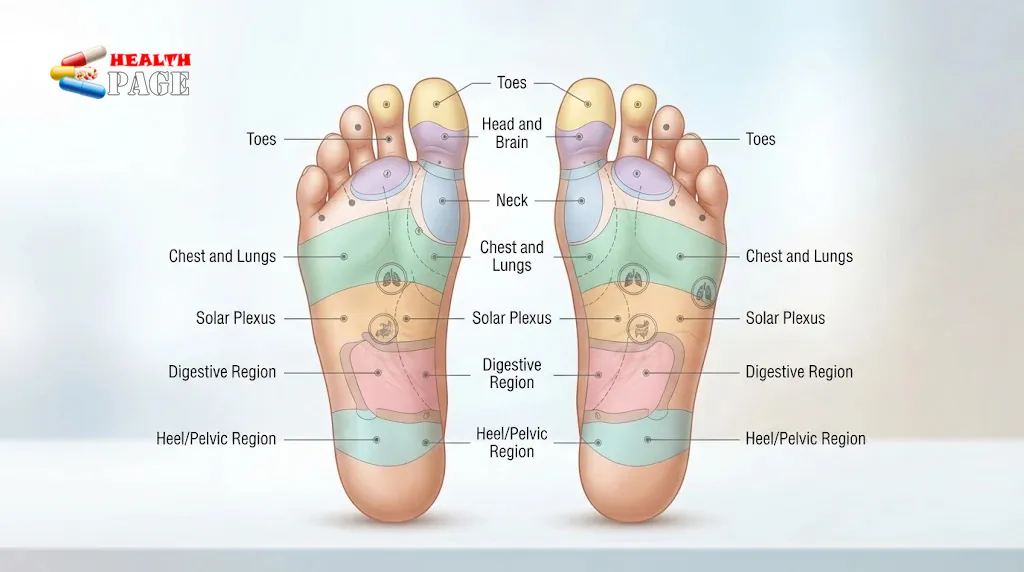
A foot reflexology chart is a diagram that divides the sole, toes and edges of the foot into zones, each traditionally linked to a part of the body. Toes stand for the head, the arch for the digestive organs, the heel for the pelvis, and so on. People use these charts as a guide for foot massage, and practitioners use them to decide where to apply pressure.
It helps to know one thing before you start reading one. The chart describes a traditional belief system, not a verified map of human anatomy. This guide explains how to read the chart, what each of the seven main areas is said to represent, how the left and right feet differ, and what the research says about it all. It also covers who should avoid pressure massage.
What Is a Foot Reflexology Chart?
Reflexology is built on the idea that specific points on the feet correspond to other organs and body parts. In the words of Victoria’s Better Health Channel, modern reflexology holds that the foot has “reflex” points matching structures throughout the body, and that massaging them promotes wellness elsewhere. One example it gives is that the tip of the left big toe corresponds to the left hemisphere of the brain.
A chart turns that idea into a picture. Most show both soles from below, with labels or colour-coded zones. You may see it called a foot reflexology map, a foot pressure point chart or a foot organ reflexology chart. The names differ, but the purpose is the same.
Not every chart agrees with the others. Different schools of reflexology draw zone boundaries in slightly different places and label some organs differently. A chart is better thought of as one tradition’s interpretation than as a standard reference.
Understanding the Main Areas of a Foot Reflexology Chart
Most charts follow the foot’s own landmarks, which makes them easier to read once you know where the regions sit.
The toes represent the upper body, mainly the head and neck. The ball of the foot, the padded area just below the toes, is linked to the upper torso. The arch is the central body and abdomen. The heel is the lower body and pelvis. The inner edge, running from the big toe to the heel, is traditionally the spine, while the outer edge stands for the shoulder, arm and hip regions in many charts.
The layout works like a miniature body laid along the foot: head at the toes, pelvis at the heel. Once you see that, the rest of the chart mostly falls into place.
Right Foot Reflexology Chart: What the Zones Represent
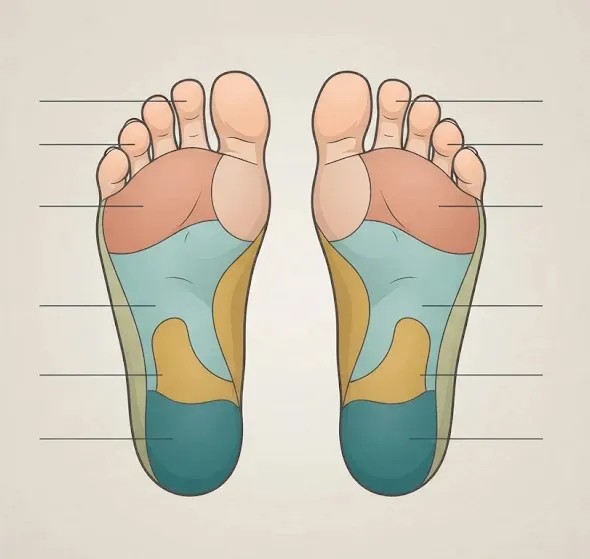
On a right foot reflexology chart, zones for organs that sit mainly on the right side of the body are placed on the right foot. The liver and gallbladder are the usual examples, and they appear in the upper-middle arch area. Parts of the digestive tract, such as the ascending colon, are also commonly shown there.
The logic is mirror-like: the right foot corresponds to the right side of the body. A few organs, such as the liver, are drawn almost exclusively on one foot because they sit mainly on one side.
Left Foot Reflexology Chart: What the Zones Represent
The left foot reflexology chart follows the same logic for the left side of the body. Here, many charts place the heart in a small zone near the ball of the foot, along with the spleen, the pancreas and most of the stomach. The descending colon is also usually marked here.
Midline structures like the spine, throat and brain are shown on both feet, since each foot holds half of the “map.”
These are chart conventions, not anatomical facts. Pressing on the left foot has not been shown to affect the heart, and the placement of the heart zone changes from one chart to another.
Female Foot Reflexology Chart: Reproductive Zones Explained
A female foot reflexology chart is not a separate system. It usually uses the same toe-to-heel layout as any other chart, with additional labels for the female reproductive organs. The ovaries and uterus are normally placed around the inner and outer ankle bones and the lower heel, and some charts add a breast zone on the upper part of the foot, near the base of the toes.
Because these zones sit in the pelvic region of the map, they appear in discussions of period pain, fertility and hormones. This is where caution matters most. There is no reliable evidence that pressing these points treats infertility, menstrual disorders, hormonal imbalance or gynaecological disease. If you are trying to conceive or dealing with a reproductive health problem, a clinician-led approach, such as the fertility options explained in this guide to IUI treatment, is a more reliable path than a chart.
7 Key Foot Reflexology Pressure Points and Their Traditional Uses
Foot reflexology pressure points are often simplified into seven regions. They are not seven medically validated treatment points. They are a practical way of organising the chart, and their exact boundaries vary.
| Area of the foot | Traditionally linked to |
|---|---|
| Big toes | Head and brain |
| Smaller toes | Eyes, ears, sinuses |
| Base of the toes | Neck and throat |
| Ball of the foot | Chest and lungs |
| Upper arch | Solar plexus, upper abdomen |
| Middle arch | Stomach, liver, kidneys, intestines |
| Heel | Pelvic and reproductive regions |
Head and brain area
The pads of the big toes are the most consistently labelled zone across charts. In practice, people use this area for a gentle pressure massage, often during stress or when they feel mentally tired.
Eyes, ears and sinus area
The four smaller toes carry this label. Massaging the tips is a common part of a relaxing session, and some people use it when feeling congested. There is no firm evidence that it clears sinuses or improves eyesight or hearing.
Neck and throat area
The base of the big toe, where it meets the foot, is typically labelled as the neck. It is a comfortable place to work for people who hold tension in their shoulders and upper back, though the effect, if any, is likely to be the general relaxation of massage.
Chest and lung area
The ball of the foot is the chest zone. Charts typically place the lungs and bronchi here, and some also mark the heart on the left side. If you want to understand what the lungs actually do, how the respiratory system works is a good place to begin, because the chart tells you nothing about lung function.
Solar plexus area
The solar plexus is a network of nerves in the upper abdomen. On a chart it sits in the upper arch, slightly below the ball of the foot. Practitioners often start here because it is considered a calming point, and a few slow, gentle presses are a common way to open a session.
Digestive and abdominal area
The middle of the arch covers the stomach, liver, kidneys, pancreas and intestines. Stomach, spleen and pancreas appear mainly on the left foot, while the liver and gallbladder appear on the right. Of the seven, this is the one most often claimed to “treat” digestive problems, and the claim is not backed by reliable evidence.
Heel and pelvic area
The heel is the pelvic region, with the lower back and sciatic area marked toward the centre. Heel tenderness is common simply from standing or walking on hard surfaces, so it should not be read as a sign of pelvic problems.
How to Read and Use a Foot Reflexology Chart
Start by identifying which foot you are looking at. Many charts show both soles from underneath, so the big toes point toward each other in the middle. A quick check is to find the arch: it curves inward on the inside of each foot.
Then find the landmarks: toes, ball, arch, heel. Read the labels as traditional associations, not as diagnoses.
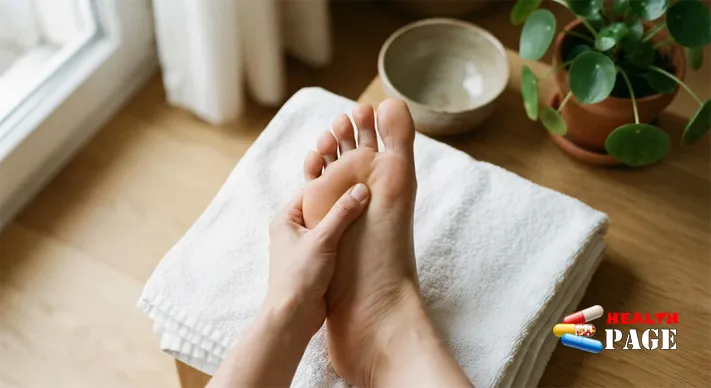
If you want to try gentle massage at home, a simple approach is enough:
- Sit comfortably and support your foot on your knee.
- Warm the foot with a few slow strokes from toes to heel.
- Use the pad of your thumb, not your nail, to press on one zone.
- Hold for a few seconds, then release and make small circles.
- Move to another zone and repeat on the other foot.
Pressure should be firm but comfortable, never sharp. Two or three zones for a few minutes each is plenty. You do not need to work the whole chart in one sitting.
Tenderness in a particular spot does not mean a matching organ has a problem. Sore spots can come from walking, tight shoes, stress, cold feet, calluses, dry skin or tired muscles. Treating tenderness as a diagnosis is one of the most common misunderstandings about these charts.
Potential Benefits of Foot Massage and Reflexology
Many people find that foot massage is simply pleasant. It can ease tired feet, encourage you to slow down, and help you relax. Those effects are real in the sense that people report them, and they are the most plausible foot reflexology benefits.
The Cleveland Clinic notes that research on reflexology is of low quality and that no well-designed studies show it works better than ordinary foot massage. Its summary is that a foot massage may help mood, stress, energy and sleep, and that the benefits of reflexology may be the same ones.
So the practical value is probably relaxation and comfort. That is worth having, as long as it is not confused with treatment.
Does Foot Reflexology Really Work?
It depends on what you mean by “work.” As a way to relax, many people find it helpful. As a way to diagnose or treat disease through specific points, the evidence does not support it.
The US National Center for Complementary and Integrative Health (NCCIH) describes reflexology as applying pressure to points on the feet or hands that are believed to match other parts of the body, and states that the claimed relaxation and healing effects in those parts have not been proven. It reports that one National Cancer Institute-funded study in women with advanced breast cancer found some improvement in symptoms such as shortness of breath, but not in others such as nausea or pain. It also describes only a small amount of research on multiple sclerosis symptoms and too little evidence on irritable bowel syndrome to draw conclusions.
In plain terms, nobody has demonstrated that a spot on the foot is wired to a particular organ. Some people feel better after a session, and the likeliest explanation is the nonspecific effect of touch, attention and rest. That does not make the experience worthless, but it does mean a chart should never replace a medical examination.
Safety Precautions and Who Should Avoid Foot Reflexology
Gentle massage is low-risk for most healthy people, but there are situations where you should hold off or check with a professional first.
- Injuries or fractures: avoid pressure until the foot or ankle has been assessed and healed.
- Open wounds or skin infections: do not massage the affected area.
- Diabetes or reduced foot sensation: speak to a healthcare professional first, because you may not feel damage as it happens.
- Circulation problems: get medical advice before trying pressure massage.
- Sudden leg swelling, warmth or pain in one calf: do not massage. These can signal a blood clot and need urgent assessment.
- Fever or acute illness: postpone.
- Severe or unexplained foot pain: find the cause rather than assuming it is a reflexology point.
Pregnancy deserves particular care. The Cleveland Clinic advises telling a reflexologist if you are pregnant, because some points on the foot are believed to help induce labour. If you are expecting and dealing with pelvic discomfort, it is better to understand its likely causes first, as set out in this guide to pain in the pubic bone while pregnant, and to ask your midwife or doctor before trying targeted pressure.
Massage should never cause sharp pain, strong pressure is unnecessary, and it should never delay a diagnosis. Reflexology is not a replacement for prescribed medication or treatment.
Frequently Asked Questions
What is a foot reflexology chart used for?
Mostly as a guide for where to apply pressure during foot massage. It shows which area of the foot is traditionally linked to which body part. It is an educational and practical aid, not a diagnostic tool.
Are the right and left foot reflexology charts different?
Yes, in some details. Organs that sit mainly on one side, such as the liver on the right and the spleen on the left, are placed on the matching foot, while midline structures appear on both. Charts from different schools do not always match exactly.
Is there a separate female foot reflexology chart?
Not really. The basic layout is the same, with extra labels for reproductive organs such as the ovaries and uterus, usually near the ankle and heel. These labels reflect tradition rather than proven physiology.
Can foot reflexology identify health problems?
No. A tender spot can be caused by footwear, activity, tight muscles or skin conditions. Any persistent or unexplained pain should be checked by a doctor.
Can I perform foot reflexology at home?
Yes, gentle thumb-pad massage is generally fine for healthy adults. Keep the pressure comfortable, work on a few zones at a time, and avoid it if you have an injury, wound, circulation problem or reduced sensation.
Conclusion
A foot reflexology chart is a useful way to understand how traditional reflexology organises the foot, from the toes at the top of the body to the heel at the bottom, and from the right foot’s liver zone to the left foot’s heart and stomach zones. It can guide a relaxing foot massage, and many people enjoy it for that reason.
It is not proof of a hidden map to the organs. Treat the chart as a tradition, enjoy the relaxation it can bring, and see a doctor for pain, swelling or anything that worries you. If you decide to try reflexology, do it gently and keep it as an addition to proper medical care, not a replacement.
Meta Description (Rank Math): A foot reflexology chart maps traditional pressure points on the feet. See how to read it, what each zone means, what research shows and who should be careful.
SEO Title: Foot Reflexology Chart: 7 Key Pressure Points and What They Mean
Slug: foot-reflexology-chart
Schema Type: Article. MedicalWebPage would also fit if a clinician reviews the page. I would not add FAQPage just because an FAQ section exists.
References
- NCCIH (US National Institutes of Health), Reflexology. https://www.nccih.nih.gov/health/reflexology
- Better Health Channel (Victoria State Government), Reflexology. https://www.betterhealth.vic.gov.au/health/conditionsandtreatments/reflexology
- Cleveland Clinic, Reflexology. https://health.clevelandclinic.org/reflexology/

Dr. Sana Lodhi is a qualified medical doctor (MBBS) with a strong commitment to patient care and evidence‑based medicine. With years of clinical experience and her current role at Liaquat University of Medical & Health Sciences (LUMHS), she brings trusted medical insights to readers, simplifying complex health topics into clear, practical guidance. Her passion lies in promoting preventive healthcare, empowering individuals to make informed decisions, and bridging the gap between medical knowledge and everyday wellness. At HealthyPost.co.uk, Dr. Lodhi shares expert perspectives on health, lifestyle, and medical awareness to help readers live healthier, more balanced lives.