

Is it safe to take famotidine 40 mg twice a day
If you have been prescribed a higher acid-reducing dose, you may be wondering, is it safe to take famotidine 40 mg twice a day? That is a very reasonable question. Many people know famotidine as a common medication for heartburn or acid reflux, but a dose of 40 mg twice daily can sound strong at first. The reassuring answer is that, in the right medical setting, this dose has been studied and was found to be safe and well tolerated in many patients.
Still, safety never depends on dosage alone. It depends on why you are taking it, how long you need it, your age, kidney function, and what other medicines you use. That is why this topic deserves a careful, practical explanation.
In this article, we will walk through what a landmark clinical trial found, what what is famotidine used for really means in daily practice, how famotidine 20mg compares with famotidine 40 mg, and what to know about famotidine side effects. The goal is simple: help you understand the evidence without medical jargon, so you can have a better conversation with your clinician 💙
1. What Is Famotidine Used for?
Before discussing dose safety, it helps to understand what is famotidine used for.
Famotidine uses include reducing stomach acid in conditions such as:
- Heartburn
- Acid reflux
- GERD
- Erosive esophagitis
- Stomach and duodenal ulcers
- Conditions with excess acid production
Famotidine belongs to a class called H2 blockers. It works by reducing the amount of acid the stomach makes. Think of it like turning down the volume on acid production rather than shutting it off completely.
This matters because some people need mild acid control, while others have visible injury in the esophagus. In those more serious cases, a stronger dose may be needed for healing.
For general drug information, the famotidine overview from MedlinePlus offers a useful starting point.
2. Why People Ask About 40 mg Twice a Day
Many people are more familiar with lower doses like famotidine 20 mg or occasional over-the-counter use. So when they hear famotidine 40 mg twice daily, it can raise concern.
That concern often comes from three places:
- The number sounds high
- People compare it to over-the-counter strengths
- They worry about long-term medication risks
Those concerns are valid. But a prescription dose is not judged by how large it sounds. It is judged by evidence, patient need, and doctor supervision.
In some digestive conditions, especially erosive or ulcerative reflux esophagitis, a low dose may not be enough to heal tissue damage. In that setting, the question is not just “Will it reduce symptoms?” It is also “Will it help the esophagus heal?”
3. What the 1993 Study Found
A key study directly compared two treatment plans:
- Famotidine 20 mg twice daily
- Famotidine 40 mg twice daily
The study was titled: Efficacy of famotidine 20 mg twice a day versus 40 mg twice a day in the treatment of erosive or ulcerative reflux esophagitis
Study details
- Authors: Wesdorp IC, Dekker W, Festen HP
- Journal: Digestive Diseases and Sciences
- Publication date: December 1993
- PMID: 8261835
Study design
This was a strong clinical design for its time:
- Double-blind
- Randomized
- Multicenter
- 474 symptomatic patients
- 12 weeks of treatment
Treatment groups
- 238 patients received famotidine 20 mg twice daily
- 236 patients received famotidine 40 mg twice daily
What researchers measured
They looked at:
- Healing of esophageal lesions by endoscopy
- Relief of heartburn
- Relief of regurgitation
- Relief of dysphagia
- Safety and tolerability
This is important. The study did not only ask whether patients “felt better.” It also checked whether the esophagus actually healed.
4. Is It Safe to Take Famotidine 40 mg Twice a Day According to the Study?
Based on this trial, is it safe to take famotidine 40 mg twice a day? In the population studied, yes. Both dose groups were reported to be safe and well tolerated, and there was no major difference in adverse events between the 20 mg and 40 mg twice-daily regimens.
That finding matters because it separates two issues:
- Effectiveness
- Safety
The higher dose was not just more effective. It was also tolerated similarly to the lower dose in this study.
In plain language, the higher dose gave patients a better chance of healing without creating a major safety tradeoff in the trial.
That does not mean every person should take it. It means the dose has evidence behind it when prescribed for the right condition.
5. The Most Important Result: Higher Healing Rates
The central finding of the study was clear: famotidine 40 mg twice daily worked better than famotidine 20 mg twice daily for erosive or ulcerative reflux esophagitis.
The difference was especially noticeable:
- At 6 weeks
- At 12 weeks
This tells us something useful. A stronger dose did not simply provide short-term comfort. It improved actual healing over time.
If someone has reflux bad enough to damage the lining of the esophagus, healing becomes the main goal. Symptom relief matters, but tissue recovery matters more.
Why healing matters
When esophageal irritation continues, it can lead to:
- Ongoing pain or burning
- Trouble swallowing
- Poor sleep
- Eating discomfort
- Chronic inflammation
A patient may say, “The burning is a little better.” But the scope may still show injury. That is why higher healing rates are clinically meaningful.
6. Symptom Relief Was Better Too
The study also found greater improvement in:
- Heartburn
- Regurgitation
Dysphagia improved similarly in both groups.
This pattern makes sense. Stronger acid reduction often helps when symptoms are driven by repeated acid exposure. For many patients, the experience is not just occasional discomfort. It can feel like a daily interruption to meals, sleep, and peace of mind.
Imagine someone who wakes at 2 a.m. with burning in the chest three nights each week. Even modest symptom improvement can change daily life. Faster symptom relief may mean better sleep, less anxiety around food, and fewer disruptions at work.
7. Safety Does Not Mean “Right for Everyone”
Here is the key nuance: when we ask, is it safe to take famotidine 40 mg twice a day, the answer is not a universal yes for every person.
It is safer to say this:
Famotidine 40 mg twice daily was safe and well tolerated in the studied group, but individual safety depends on your health profile.
Factors that may affect safety include:
- Kidney disease
- Older age
- Other acid-reducing medicines
- Drug interactions
- Underlying stomach symptoms that need evaluation
- Long-term unsupervised use
Because famotidine is cleared partly through the kidneys, some patients need dose adjustment. That is especially important in older adults or those with reduced kidney function.
If someone self-treats severe reflux for months without medical advice, they may miss a more serious condition. That is one reason professional evaluation matters.
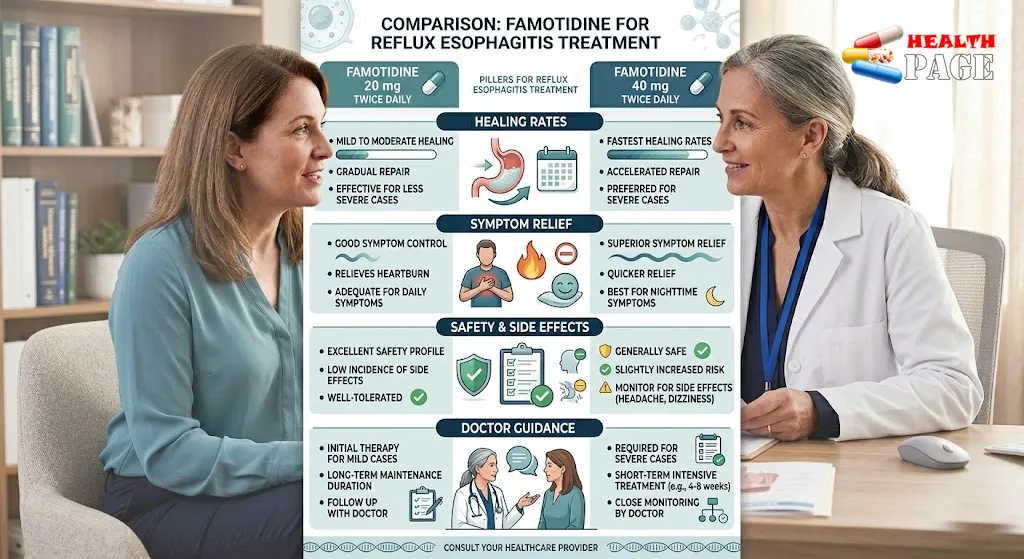
8. Famotidine 20 mg vs 40 mg Twice Daily
The difference between famotidine 20mg and famotidine 40 mg is not just a bigger number. It may reflect a different treatment goal.
| Dose | Typical Purpose in Context | Study Outcome | Tolerability |
|---|---|---|---|
| Famotidine 20 mg twice daily | Acid reduction for milder treatment needs | Effective, but less healing than 40 mg BID | Well tolerated |
| Famotidine 40 mg twice daily | More intensive treatment for erosive reflux esophagitis | Significantly better healing and symptom relief | Also well tolerated |
This table highlights an important point. Lower dose treatment may help many people, but more severe disease often needs stronger therapy.

9. Common Famotidine Side Effects to Know
Even though the study found both doses well tolerated, it is still important to understand possible famotidine side effects.
Common side effects may include:
Less common but more serious concerns can include:
- Confusion, especially in some older adults
- Allergic reaction
- Irregular heartbeat
- Unusual fatigue
Most people do not experience severe problems. Still, any new symptom after starting medication should be reviewed, especially if it feels unusual or intense.
For a broader public health overview of GERD, the National Institute of Diabetes and Digestive and Kidney Diseases explains symptoms and treatment approaches clearly.
10. Why This Study Still Matters Today
The study was done in the early 1990s. That is important context. Since then, proton pump inhibitors, or PPIs, became the standard treatment for more severe reflux esophagitis because they usually heal erosive disease more effectively.
So why does this study still matter?
Because not everyone can take a PPI.
Some people:
- Do not tolerate PPIs
- Need an H2 blocker instead
- Use famotidine in a specific clinical plan
- Need an alternative due to side effects or interactions
In those cases, evidence about famotidine uses remains relevant. The study helps answer a practical question clinicians still face: if famotidine is being used for erosive reflux disease, is a higher dose justified?
The answer from this trial was yes. It improved healing and symptom relief without reducing tolerability.
11. Modern Clinical Perspective
In today’s practice, if someone has severe erosive esophagitis, many clinicians may prefer a PPI first. That is because PPIs generally offer stronger acid suppression.
Still, famotidine remains an important medication. It can be used:
- For milder reflux symptoms
- In people who cannot take PPIs
- As part of a step-down or alternative strategy
- In selected supervised treatment plans
So, is it safe to take famotidine 40 mg twice a day in modern care? It can be, when prescribed for an appropriate reason and monitored by a healthcare professional.
That is the difference between evidence-based treatment and self-dosing.
12. Practical Real-Life Examples
Example 1: Mild occasional heartburn
A person has heartburn after spicy dinners twice a month. They may not need famotidine 40 mg twice daily. A lower dose or occasional use may be enough.
Example 2: Documented erosive esophagitis
A patient has persistent reflux, painful swallowing, and endoscopy confirms erosive damage. In that setting, a more intensive dose may make clinical sense.
Example 3: Kidney disease
A person has chronic kidney impairment and daily reflux symptoms. Even if famotidine 40 mg twice daily was effective in studies, the dose may need adjustment.
These examples show why the same medicine can be reasonable for one patient and unsuitable for another.
13. When to Talk to a Doctor Before Taking This Dose
You should not guess your way through significant reflux symptoms. Speak with a healthcare professional before using a high-dose schedule if you have:
- Symptoms lasting more than a few weeks
- Trouble swallowing
- Vomiting
- Weight loss
- Black stools
- Chest pain
- Kidney disease
- Older age with multiple medications
- Pregnancy or breastfeeding concerns
These situations need more than symptom control. They need medical judgment.
For additional prescribing and safety details, the famotidine injection prescribing information from the FDA provides official drug-label information, though it is more technical.
14. Questions Patients Often Ask
People often ask whether taking two 40 mg doses a day is “too much.” The answer depends on context. For occasional heartburn, it may be more than needed. For documented erosive reflux disease under medical care, it may be appropriate.
Another concern is whether taking more medicine always means more side effects. Not necessarily. In this study, the higher dose did not lead to a significant increase in adverse events.
That is one of the most helpful takeaways from the research.
15. Signs the Medication May Be Helping
When famotidine is working, people may notice:
- Less heartburn
- Less regurgitation
- Reduced nighttime symptoms
- Easier swallowing
- Better sleep
- Less meal-related discomfort
Still, symptom improvement is only one part of the picture. In erosive disease, healing may need endoscopic confirmation, especially if symptoms were severe.
16. Signs You Need Follow-Up Instead of More Self-Treatment
Do not simply increase your dose on your own if symptoms continue. Follow-up matters if:
- Symptoms return quickly
- Swallowing becomes painful
- You need ongoing daily treatment
- You are relying on acid medicine for months
- You develop new digestive symptoms
This is especially true when asking, is it safe to take famotidine 40 mg twice a day for a long period. A dose can be safe in a study and still require individual review during prolonged use.
17. Key Takeaways From the Evidence
Let’s bring the evidence together in simple terms:
- Famotidine 40 mg twice daily was more effective than famotidine 20 mg twice daily
- The higher dose improved healing of erosive or ulcerative reflux esophagitis
- It also improved heartburn and regurgitation more effectively
- Both dose regimens were safe and well tolerated in the study
- Modern practice often prefers PPIs for severe disease
- Famotidine still has a role for selected patients
This is the kind of information that helps patients feel less overwhelmed. Numbers on a prescription label can look intimidating. Evidence helps put them into perspective.
FAQs
1. Is it safe to take famotidine 40 mg twice a day?
In the 1993 clinical trial, this dose was safe and well tolerated in patients with erosive or ulcerative reflux esophagitis. Still, personal safety depends on your health and medical supervision.
2. Is famotidine 40 mg twice daily better than famotidine 20 mg twice daily?
Yes, in that study, famotidine 40 mg twice daily healed esophageal lesions better and improved heartburn and regurgitation more than famotidine 20 mg twice daily.
3. What is famotidine used for?
What is famotidine used for includes heartburn, acid reflux, GERD, ulcers, and some acid-related stomach conditions.
4. What are common famotidine side effects?
Common famotidine side effects include headache, dizziness, constipation, and diarrhea. Serious side effects are less common but should be reviewed promptly.
5. Can I take famotidine 20mg instead of 40 mg?
Possibly, but it depends on why you are taking it. Famotidine 20mg may be enough for milder symptoms, while more severe erosive disease may require a higher dose.
6. Are PPIs better than famotidine for severe reflux?
Often, yes. In modern practice, PPIs are usually preferred for severe erosive esophagitis because they tend to heal the esophagus more effectively.
Conclusion
So, is it safe to take famotidine 40 mg twice a day? The evidence from a well-designed clinical trial suggests that, for patients with erosive or ulcerative reflux esophagitis, this dosing schedule was safe, well tolerated, and more effective than famotidine 20 mg twice daily. It improved healing and gave better relief from heartburn and regurgitation.
At the same time, safety is never one-size-fits-all. Your age, kidney function, diagnosis, and treatment goals all matter. For some people, famotidine 40 mg twice daily is appropriate. For others, a lower dose, a different schedule, or another medication may be better.
If you are asking yourself, is it safe to take famotidine 40 mg twice a day, the best next step is simple: review your symptoms and medical history with a qualified clinician. That conversation can turn uncertainty into a treatment plan you can trust 🤝
References
- Wesdorp IC, Dekker W, Festen HP. Efficacy of famotidine 20 mg twice a day versus 40 mg twice a day in the treatment of erosive or ulcerative reflux esophagitis. Digestive Diseases and Sciences. 1993 Dec. PMID: 8261835.
- MedlinePlus. famotidine
- NIDDK. GERD
