

7 Essential Facts About ICD 10 Code for High Cholesterol You Can’t Ignore
If you or someone you love has been told they have high cholesterol, the medical paperwork can feel confusing. One term that often appears in records and insurance claims is the icd 10 code for high cholesterol. It may look like a simple billing label, but it carries real weight. It guides diagnosis, supports treatment plans, and helps insurance systems process claims correctly. 🩺
For many patients, this code sits quietly in the background. Yet for clinicians, coders, and healthcare organizations, it is a core part of accurate documentation. The current ICD-10-CM code used for pure hypercholesterolemia, unspecified, is E78.00, effective in the 2026 edition starting October 1, 2025. Understanding what that means can save time, reduce claim denials, and improve care decisions.
This article breaks the topic into clear, practical facts. If you have ever wondered what E78.00 means, when it is used, or how it differs from other lipid disorder codes, you are in the right place.
1. The current ICD-10-CM code for high cholesterol is E78.00
The most important fact is also the simplest. The current icd 10 code for high cholesterol is:
- Code: E78.00
- Description: Pure hypercholesterolemia, unspecified
- Effective date: October 1, 2025
- Edition: 2026 ICD-10-CM
This code falls under the broader E78 category, which covers disorders of lipoprotein metabolism and other lipidemias.
In plain terms, E78.00 is used when a patient has elevated cholesterol levels consistent with pure hypercholesterolemia, but the record does not specify a more detailed subtype beyond that standard diagnosis.
Why “unspecified” matters
The word “unspecified” does not mean careless medicine. It means the available documentation supports pure hypercholesterolemia, but not a more narrowly defined classification. That distinction matters in coding.
For example, a clinician may confirm elevated LDL cholesterol and diagnose hypercholesterolemia. If no further subtype is documented, E78.00 may be appropriate.
Real-life example
A 52-year-old patient comes in for a wellness visit. Their lipid panel shows persistently elevated LDL cholesterol. The physician diagnoses pure hypercholesterolemia and starts treatment. If the note does not define another specific lipid disorder, E78.00 is often the billable code used.
2. E78.00 is a billable code, and that affects reimbursement
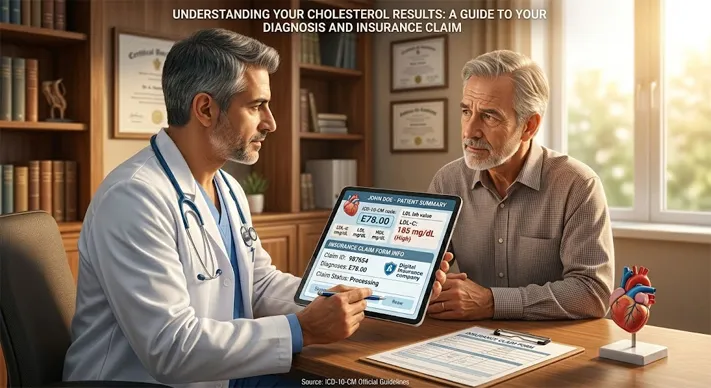
One of the biggest reasons the icd 10 code for high cholesterol matters is billing. E78.00 is a billable ICD-10-CM code. That means it can be used on claims for reimbursement and medical documentation.
Without the right diagnosis code, even routine services can hit delays.
Why billable status matters
A billable code helps support:
- Insurance claim submission
- Medical necessity documentation
- Reimbursement for visits and follow-up care
- Population health reporting
- Consistent recordkeeping across care settings
If a patient receives lab monitoring, counseling, or medication management for high cholesterol, the diagnosis code helps explain why that care was needed.
The cost of getting it wrong
Inaccurate coding can lead to:
- Claim denials
- Payment delays
- Requests for corrected documentation
- Confusion in future treatment records
This is why documentation precision matters so much. In a busy practice, a small coding error can create a long administrative trail.
For official classification details, clinicians often cross-check the ICD-10-CM code E78.00 within current coding resources and payer guidance.
3. High cholesterol is more than a number on a lab report
Coding may sound administrative, but it is rooted in clinical reality. High cholesterol is not just a line item. It is a known cardiovascular risk factor that deserves attention. ❤️
Hypercholesterolemia is a disorder of lipid metabolism. When cholesterol, especially LDL cholesterol, stays elevated over time, plaque can build up in arteries. That process raises the risk of:
- Coronary artery disease
- Stroke
- Peripheral vascular disease
- Heart attack
- Long-term vascular complications
Why the diagnosis code reflects real risk
The icd 10 code for high cholesterol is not there only for paperwork. It helps track a condition that can quietly affect health for years before symptoms appear.
Many people feel completely well while cholesterol is climbing. That is why regular screening matters. A diagnosis code like E78.00 creates a formal record that follow-up care is needed.
A simple way to think about it
Think of cholesterol like rust forming inside a pipe. You may not see the damage at first. But over time, flow becomes restricted, pressure rises, and the system becomes vulnerable. Early recognition helps prevent bigger problems later.
Trusted medical context
The high cholesterol guidance from the CDC explains how elevated cholesterol contributes to heart disease risk and why monitoring is important.
4. E78.00 belongs to a larger family of E78 lipid disorder codes
Not every cholesterol-related diagnosis uses the same code. E78.00 sits within a larger coding family. Understanding that family helps avoid confusion and improves documentation accuracy.
Related ICD-10 codes in the E78 category
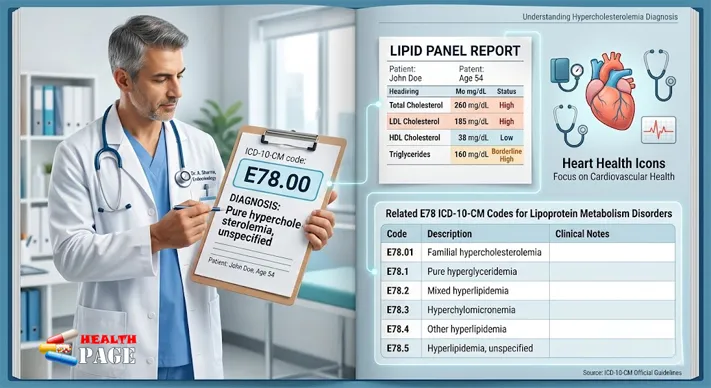
| Code | Description |
|---|---|
| E78.0 | Pure hypercholesterolemia |
| E78.00 | Pure hypercholesterolemia, unspecified |
| E78.1 | Pure hyperglyceridemia |
| E78.2 | Mixed hyperlipidemia |
| E78.3 | Hyperchylomicronemia |
| E78.4 | Other hyperlipidemia |
| E78.5 | Hyperlipidemia, unspecified |
| E78.6 | Lipoprotein deficiency |
| E78.7 | Disorder of lipoprotein metabolism, unspecified |
This table shows why precise diagnosis language matters. “High cholesterol” may sound broad in everyday speech, but coding requires a closer match.
E78.00 versus E78.5
This distinction causes confusion.
- E78.00 refers to pure hypercholesterolemia, unspecified
- E78.5 refers to hyperlipidemia, unspecified
If documentation clearly points to elevated cholesterol, E78.00 is more specific than E78.5. If the chart only says “hyperlipidemia” without detail, E78.5 may be used instead.
Practical example
If a chart says, “Patient has elevated LDL and diagnosed with pure hypercholesterolemia,” E78.00 fits.
If it says only, “Patient has hyperlipidemia,” without more detail, a broader code may be necessary.
5. E78.00 applies to several recognized diagnostic descriptions
Another essential fact is that E78.00 is linked to several applicable terms. This helps coders and clinicians map chart language correctly.
Applicable to
E78.00 may apply to:
- Fredrickson’s hyperlipoproteinemia, type IIa
- Hyperbetalipoproteinemia
- LDL-type hyperlipoproteinemia
- Pure hypercholesterolemia NOS
- Pure hypercholesterolemia, unspecified
These terms may look technical, but they often describe related patterns of elevated cholesterol, especially involving LDL particles.
Why this matters in documentation
A provider may use one of these diagnostic terms in a chart note or consult letter. A trained coder then matches that wording to the appropriate ICD-10-CM code.
This is especially useful in specialty care, where terminology may be more specific than in primary care.
Keep the chart language clear
For providers, it helps to document:
- Whether cholesterol is the main abnormality
- Whether triglycerides are also elevated
- Whether the condition is pure hypercholesterolemia or mixed dyslipidemia
- Whether ongoing treatment is being managed
Clear notes reduce ambiguity. That supports both patient care and cleaner claim submission.
6. Accurate coding supports treatment planning and long-term monitoring
The icd 10 code for high cholesterol does more than justify a claim. It supports continuity of care over time. That matters because high cholesterol is rarely managed in a single visit.
Typical follow-up steps after diagnosis
Once E78.00 is documented, care may include:
- Repeat lipid panel testing
- Cardiovascular risk assessment
- Diet and lifestyle counseling
- Medication review
- Statin therapy when appropriate
- Monitoring for treatment response
The diagnosis code creates a record that the patient needs ongoing attention.
Why monitoring matters
A patient with elevated cholesterol may also have:
- High blood pressure
- Diabetes
- Obesity
- Family history of early heart disease
- Smoking history
In those cases, the overall cardiovascular risk climbs. The diagnosis then becomes part of a bigger clinical picture.
A practical scenario
A patient starts a statin after repeated high LDL results. Three months later, the physician orders repeat labs. E78.00 helps connect those follow-up services to the underlying diagnosis.
For evidence-based prevention guidance, the cholesterol management recommendations from the American Heart Association provide useful patient and clinician context.
7. Coding rules can vary by country, so the U.S. ICD-10-CM version matters
This final fact is often overlooked. The code discussed here is part of the American ICD-10-CM system. Other countries may use different versions of ICD-10. The structure may look similar, but coding conventions can differ.
Why this distinction matters
If you work with international records, global telehealth, or cross-border documentation, do not assume that the same code works everywhere.
The article’s focus is the U.S. standard:
- System: ICD-10-CM
- Country: United States
- Code: E78.00
- Effective date: October 1, 2025
Best practice for coders and practices
Always verify:
- The country-specific coding system
- The effective year of the code set
- Payer-specific documentation requirements
- Whether the diagnosis note supports the selected code
That extra step can prevent errors, especially when teams use templates or imported records from other systems.
What clinicians and patients should remember about E78.00
By now, one thing is clear. E78.00 is not a trivial label. It is a practical tool used every day in modern healthcare.
Key takeaways at a glance 📌
- The current icd 10 code for high cholesterol is E78.00
- It means pure hypercholesterolemia, unspecified
- It is effective in the 2026 ICD-10-CM edition from October 1, 2025
- It is billable
- It falls under E78, the category for lipid metabolism disorders
- It supports diagnosis, treatment planning, and reimbursement
- It differs from broader codes like E78.5
A patient-centered reminder
If your chart includes E78.00, it does not automatically mean severe disease. It means your medical team has identified a cholesterol disorder that deserves follow-up. In many cases, lifestyle changes and medication can reduce risk substantially.
That is why coding and care should work together, not separately.
FAQs About ICD-10 Code for High Cholesterol
What is the ICD-10-CM code for high cholesterol?
The current icd 10 code for high cholesterol is E78.00. It stands for pure hypercholesterolemia, unspecified.
Is E78.00 a billable code?
Yes. E78.00 is a billable ICD-10-CM code used for reimbursement and medical documentation.
When did E78.00 become effective?
It is effective in the 2026 ICD-10-CM edition beginning October 1, 2025.
What category does E78.00 belong to?
It belongs to E78, which covers disorders of lipoprotein metabolism and other lipidemias.
Is E78.00 the same as hyperlipidemia, unspecified?
No. E78.00 is more specific. It refers to pure hypercholesterolemia, unspecified. Hyperlipidemia, unspecified is coded differently, often as E78.5.
Why is accurate coding important for high cholesterol?
Accurate coding supports treatment planning, helps prevent claim denials, and improves continuity of care.
Conclusion
The icd 10 code for high cholesterol may seem like a small detail, but it plays a major role in today’s healthcare system. The current ICD-10-CM code is E78.00, which stands for pure hypercholesterolemia, unspecified. It is billable, effective from October 1, 2025, and essential for documentation, treatment planning, and reimbursement. 🧾
Just as important, this code reflects a real health issue. High cholesterol can quietly increase the risk of heart disease and stroke over time. Accurate coding helps make sure that risk is seen, tracked, and managed.
If you are a patient, ask questions about your diagnosis and follow-up plan. If you are a healthcare professional, review documentation carefully and code with precision. In both cases, clear records support better care.
References
- American Heart Association. Cholesterol. https://www.heart.org/en/health-topics/cholesterol
- Centers for Medicare & Medicaid Services. ICD-10 Codes. https://www.cms.gov/medicare/coding-billing/icd-10-codes